
I received an advanced review copy of this novella from the author. I don’t normally review fantasy titles, but I made an exception for this author because I know him personally. He is one of my advanced Latin students.
My Review:
 As I have noted above I don’t usually read or review books in the fantasy genre. It’s just not something that usually catches my attention, but when Mr. Webber sent me an e-mail to request a review how could I possibly say no? He is one of the best students of Latin I have and, in fact, he is one of the most talented students I have ever had in my classes, so I was intrigued to see his writings.
Corven and the Krow is set in a pre-industrial, rural, agrarian society that one might encounter in The Lord of the Rings or, for those who are familiar with fantasy video games, in Skyrim. The novella consists of a series of shorter stories which are all interconnected. I was immediately drawn in by the set-up of the novella which describes a young girl sitting in a wagon being driven by an old man who has a large book out of which she reads this collection of stories. We have no idea what the relationship is between these two or where they are going. But is appears that these stories are meant to teach her some life lessons.
One of the figures that looms large and menacing over the entire story is the King Drevlyn, to whom we are introduced in the first story. It is this cruel and powerful king around whom all of the stories revolve. We learn that he defeated his predecessor in a bloody battle and has no mercy for anyone who did not take his side. He demands loyalty and tribute even from the lowest members of his realm, including poor farmers. If they don’t comply with the King’s demands then the punishment is swift and brutal.
The true talent of this author lies in his ability to create and fully describe an entire new world. It is an amazing feat for an author to write a story set in the here and now, the contemporary world. But I truly admire an author who can create an original world and convey the minute details about that world to others. The world of Corven and the King and the Krow have objects and settings familiar to us, but they are crafted within the text in such a way as to encompass an entirely new and different world.
Finally, I have to mention the author’s obvious appreciation for and knowledge of the classical world. The final story in the collection, Vita est Flumen (Life is a River), is an obvious nod to his classical education, but there are much deeper thoughts that are taken from Stoic philosophy. All of life is constantly in flux; life is oftentimes not fair and circumstances do not work out how we would wish. What is important in this life is our reaction to events that are out of our control. We must, essentially, go with the flow.
The author also designed his own cover art, which gives us a small preview of this fantasy world. Please check out the author’s page on Amazon for more information: https://www.amazon.com/Corven-Krow-Jacob-K-Webber-ebook/dp/B01EIVWJ7S?ie=UTF8&keywords=jacob%20k.%20webber&qid=1464550195&ref_=sr_1_1&sr=8-1
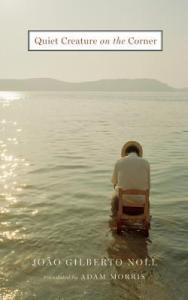 The first reaction that I had to the writing style and narrative of this book is that it feels like a series of flash fiction stories. When we first meet the narrator he lives in Porto Alegre with his mother is a decrepit, abandoned apartment. Other miscreant vagabonds also spend their days idling around the lobby of this building and doing drugs. The narrator’s actions and thoughts in the book reflect his aimless and disjointed life; he talks to his mother, he tries to write poetry, he sleeps, he wanders around the city.
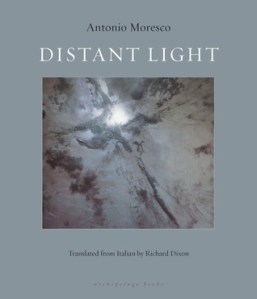 This is a short yet powerful book that raises many more questions about the mental state of the main character than it answers. We are led to understand from the beginning that the narrator is living alone in the mountains in what is now an abandoned village. The only time he has interaction with other human beings is when he drives his car down the mountain to another small village. He seems to do this only when he needs food or supplies.
 Antonio Moresco did not find a publisher until late in his career, after being turned down by several editors. His output is centred on the monumental trilogy L’increato, whose three volumes are: Gli esordi (Feltrinelli 1998, republished by Mondadori in 2011 – 673 pages), Canti del caos (part 1 by Feltrinelli in 2001, part 2 by Rizzoli in 2003; republished by Mondadori in 2009 – 1072 pages), and Gli increati (Mondadori 2015).
 I don’t normally read Dystopian, Orwellian type novels with talking Gorillas. But since this book is published by Peirene Press I decided to give it a try anyway and I am glad I did. The narrator tells us that he was living a happy life in the wild until one day members of his family start disappearing from their idyllic home. He then finds himself drugged and dragged out of his natural habitat against his will. He, along with his family, are chained together and forced on an arduous journey during which they are given just enough food and water to survive. Some of them die along the way and the living are forced to march on and leave their loved ones behind.. I found this to be the most heart wrenching and sad part of the book. Their fear was palpable and it was difficult to read about these innocent animals as they are taken out of their natural surroundings, and forced on a journey towards the unknown.
 Peter Verhelst, born in 1962, is a Belgian Flemish novelist, poet and playwright. He has written more than 20 books. His work has been praised for its powerful images, the sensuality and richness of its language and the author’s unbridled imagination. His breakthrough came in 1999 with the novel Tonguecat, which won the Golden Owl Literature Prize and the Flemish State Prize for Literature. The Man I Became is his eleventh novel.
 Adrià Guinart lives in Barcelona with his mother and adopted younger sister. But at the first chance he gets he leaves his home and joins an unnamed war that is ravaging the countryside. He is only fifteen-years-old and what he sees while the war is raging forms the bulk of this bizarre and surreal narrative. The book almost reads like a series of shorts stories, each of which is based on a different character that Adria meets while he is away from home at war.



 The Book Binder's Daughter