Tag Archives: Catullus

How Many Kisses are Enough?: My Translation of Catullus Poem 7

leighton_frederic_-_acme_and_septimius_-_c__1868

Frederic Leighton, Acme and Septimius, c 1868

Monday is the first day of the spring semester for me and even though I have been teaching for nearly twenty years I still get nervous whenever I step into a new class.  This year the enrollment in my classes are especially robust, which makes me feel even a bit more anxious.  My Honors course this semester will be translating Catullus and it is always my hope that they grow to appreciate the many layers of his intense poetry.  Since I have Catullus on my mind I thought I would continue my translation series by offering my rendition of Poem 7 which is also considered the companion piece to Poem 5 that I translated in a previous post.

Like many of Catullus’s verses,  at first glance Poem 7 seems deceptively simple.  The poem is a mere twelve lines in hendecasyllabic meter and it is about kisses.  What could be a more trivial and frivolous topic for a poem?  But a closer examination of the Latin reveals the poet’s talent at deceiving his readers:

Quaeris, quot mihi basiationes
tuae, Lesbia, sint satis superque.
quam magnus numerus Libyssae harenae
lasarpiciferis iacet Cyrenis
oraclum Iovis inter aestuosi
et Batti veteris sacrum sepulcrum;
aut quam sidera multa, cum tacet nox,
furtivos hominum vident amores:
tam te basia multa basiare
vesano satis et super Catullo est,
quae nec pernumerare curiosi
possint nec mala fascinare lingua.

You ask, Clodia, how many of your kisses
are enough or more than enough for me,
and my answer is as many as the great number of
sands that lie in the Libyan desert in silphium-bearing
Cyrene between the oracle of sultry Jove and the
sacred tomb of old Battis; or as many as the number
of stars in the sky that spy on the secret affairs of
lovers during the quiet of night.  To kiss you so many
kisses would be enough and more than enough for crazy
Catullus.  And nosy men would never be able to count
this number of kisses and put a curse on us!

I imagine that when he is composing this Catullus and Clodia are in the midst of their passionate and intense love affair; whereas in Poem 5 he seems to be still trying to woo her, in Poem 7 they have consummated their relationship.  I imagine them coming up for air after a particularly intense encounter and Clodia posing this question to him, “Just how many kisses will be enough for you, you crazy man?”  His hyperbolic response—he won’t be satisfied until he receives as many kisses as grains of sand in a desert or stars in the night sky—is fitting for the depth of their ardor.  Catullus sends this poem as a response to his lover knowing that she is a docta puella, an erudite and intelligent woman who will understand his Alexandrian references.

The Romans referred to North Africa as Libya, so that is the part of the world to which Catullus is alluding.  North Africa, and  Cyrene in particular which he also mentions, is the birthplace of the Alexandrian poet Callimachus whose style Catullus is attempting to emulate in his poetry.  In contrast to epic poets that are concerned with larger themes and the grand achievements of heroes, Callimachus and the  νεωτερικοί “new poets” of the Hellenistic Period compose brief, erudite poems about intense emotions experienced by ordinary men.  Their poems are considered highly perfected works of art in which every word is carefully chosen and placed on the page.  Catullus and his friends are considered the Latin Neoterics or, as Cicero disdainfully labeled them the Novi Poetae, and their poems are equally as intelligent and polished as those of their Greek predecessors.  By appearing to casually mention Libya and Cyrene in a love poem, Catullus is name dropping and only the most learned readers could understand that his verses are so much more than a love poem.  The reference to Battos is even more obscure since this man was a distant relative of Callimachus and the founder of Cyrene which Herodotus explains was a Greek colony of the island of Thera.

But I do think it is important to return to Catullus’s underlying inspiration and motivation for composing this poem, his love for Clodia.  He wants an infinite number of basiationes which can be playfully translated as “kissifications.”  He reminds us that their love affair is clandestine by inserting into line 8 the secret lovers who meet under the cover of night.  He subtly underscores his sexual relationship with Clodia by mentioning the silphium plant that was used as an ancient form of contraception.  And finally, he emphasizes the fact that people are gossiping—mala lingua “evil tongues”— about his time spent with Clodia whose powerful husband could destroy Catullus if word of their love ever reached his ears.  Catullus’s raw, ardent and visceral poems would not exist without the passion and risk he experiences while engaging in this love affair.
11 Comments

Filed under Classics

Let us Live and Let us Love: My Translation and Interpretation of Catullus Poem 5

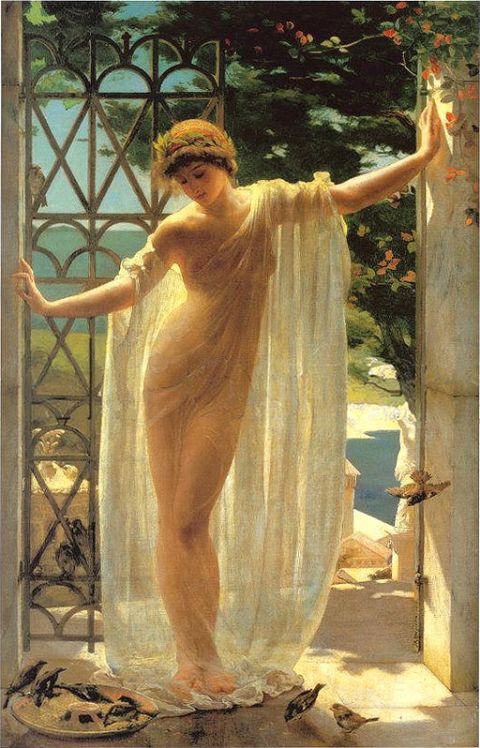
512px-john_reinhard_weguelin_lesbiaLesbia by John Reinhard Weguelin, 1878.

A dear friend who is also a classicist read my essay for the Seagull Books Catalog and pointed out that my translation of Ovid was so literal and awkward that most readers probably wouldn’t understand its meaning.  I spend my life eliciting grammatically precise, literal translations from my students so that I can assess their learning of Latin syntax.  But his message inspired me to stretch my translation skills beyond the literal and to come up with passages that readers could actually appreciate and enjoy.  Of course I also don’t want to stray so far away from the Latin that I completely abandon all rules of syntax and grammar, so it will be interesting and challenging for me to strike that balance.  I’ve decided to do a series of translations of Latin authors on my blog that will be dedicated to my friend who ever so gently gave me some suggestions for my Ovid translation.  Or, when I become frustrated with a particularly difficult Latin passage, I will blame him.

Since I am teaching a Catullus course in the spring semester, and he is my favorite Latin lyric poet, I will begin my translation series with one of his most popular poems. Gaius Valerius Catullus (c.84-54B.C.) had a passionate love affair with a woman named Clodia.  But Clodia was no ordinary woman.  Her family was of old, Patrician, noble stock and she was married to an older, prominent and powerful man, the proconsul Quintus Caecilius Metellus Celer.  As was the case with most upper class Roman marriages, Clodia’s was arranged for political and economic gains and there was no real love or affection in the marriage.  But she does find love with Catullus, who wrote several poems about her and their relationship.  I imagine him spending hours perfecting this masterpiece composed in hendecasyllabic meter and sending it off to her in secret.  And, just in case it might be intercepted by the wrong person, he disguises his love with the pseudonym “Lesbia.”

Vivamus mea Lesbia, atque amemus,
rumoresque senum severiorum
omnes unius aestimemus assis!
soles occidere et redire possunt:
nobis cum semel occidit brevis lux,
nox est perpetua una dormienda.
da mi basia mille, deinde centum,
dein mille altera, dein secunda centum,
deinde usque altera mille, deinde centum.
dein, cum milia multa fecerimus,
conturbabimus illa, ne sciamus,
aut ne quis malus inuidere possit,
cum tantum sciat esse basiorum.

Let’s live and let’s love, My Clodia,
And let’s consider worthless
The gossip of crabby old men!
Suns rise and set:
When the fleeting daylight finally sets for us,
We must spend one perpetual night together.
Give me a thousand kisses, then a hundred,
Then another thousand kisses,
Then a second hundred,
And then give me another thousand kisses
And then give me a hundred kisses.
Finally, when we have kissed many thousands of times,
Let’s mix up the number of those kisses
So that an envious man will not be able to put a curse
On us if he finds out the exact number of our kisses.

There are, of course, more salacious and explicit poems that Catullus composed about Clodia.  But I find that the subtlety and simplicity of Poem 5 makes it particularly erotic.  The standard interpretation of lines 1-6 are is the theme of carpe diem (seize the day) , with reference to our mortality but I have always viewed these lines rather differently.  The chiasmus in the first line (vivamus mea Lesbia amemus) brings to mind an image of Catullus and Clodia intertwined in bed among tangled sheets, eager for their much anticipated  sexual encounter.  He begins his poem, and his encounter with her,  slowly and languidly with the hortatory subjunctives (vivamus-“Let’s live” and amemus-“Let’s love”) and builds up to the intense immediacy of the imperative da -“give”-as he demands many kisses from her.   He is in the throws of fervent lovemaking when he uses the periphrastic (we must sleep for one perpetual night) and the anaphorae— the repetition of deinde, centum, mille—mimic the rhythm of their lovemaking.   And finally, when he has climaxed, he comes back to the more languid subjunctive forms (sciamus, possit, sciat), and suggests that the intimate details of their encounter, the exact number of their shared kisses, be mixed up so that no one will know and spoil their furtive encounters.

The hyperbole in this poem–“give me  a hundred kisses, then a thousand,” etc.–, which many have found silly, demonstrates just how much he loved her and was willing to risk to be with her.  They had to be very careful to meet secretly at the home of a trusted, mutual friend.  Catullus mentions in the first line of Poem 5 that men are gossiping about their love affair and in the last line comes back to the idea that there are those who envy the pair and wish them harm.  I imagine Catullus as a man of means, he was a wealthy Roman with high social status, who was willing to use and even risk those means to be with Clodia.  Some might accuse me of being a bad feminist, but I greatly admire Catullus, a strong man who would move heaven and earth and defy convention to spend time with the woman he loved.

I also imagine that Catullus was an infinitely patient man as weeks and even months must have gone by in between the times he was able to spend with Clodia.  When he does get to spend the night with her he doesn’t want it to end and his wish that they be suspended in one perpetual night together demonstrates how few and far between their trysts must have been. In an age of instantaneous, electronic communication and social media we seem to have lost our patience for anything and anyone who doesn’t give us immediate pleasure all the time.  I am realistic enough and old enough, some might say jaded enough, to know that an enduring love like Catullus’s is extremely rare or non-existent in an age where we so quickly swipe left, delete, unfriend, block, ignore, hide and cast aside.

Catullus’s poetry is deceptively simple and every time I translate his poems I find another layer of meaning.  Up next, I will attempt a translation of Catullus Poem 7 which is the companion piece to Poem 5 and also involves kisses.  In addition, I will explore the influence of the Greek, Alexandrian poets on Catullus’s style.   For anyone who wants to read all of Catullus’s 116 poems in translation, the Oxford World’s Classics Text by Guy Lee and the Loeb by F.W. Cornish are my favorite translations.  The Loeb translation is a bit archaic as it was published in 1913, but I find the style fitting for Catullus.

My friend who inspired these posts suggested that I translate one of  Horace’s Odes, which are nearly impossible to render into mellifluous English.  I would also like to translate some of Seneca’s Trojan Women and Ovid’s Heroides.  I would love to have more suggestions for Latin authors to translate, so please leave some requests in the comments for me!

26 Comments

Filed under Classics