Tag Archives: Art

Review: The Seagull Books Catalogue 2015-16

Seagull CatalogueI know what my readers are thinking: You are reviewing a catalogue, how boring can that be?  But please bear with me for a moment because the Seagull Catalogue of books is so much more than a listing and description of their forthcoming titles.  It is a work of art, of literature and literature in translation in its own right.

When I first suggested to Naveen at Seagull Books that I review their catalogue I was surprised to find that no one had ever done so before.  He told me that they choose a theme every year and it starts with a letter from him to everyone involved in their process, from authors to translators to booksellers.  The responses he receives from writers are translated into English and finally are passed along to their artist Sunandini so that she can design the corresponding art work.  The entire process for publishing this catalogue is impressive, to say the least, and the final product is a beautiful work of art.

Naveen’s opening letter for this catalogue, dated February 13th, contains reflections about sight Eyesand blindness and hindsight.  His letter begins, “Man will pluck their eyes.  This is known. Out of shame. And horror. Over a deed committed. Often more imagined than the truth.  Sometimes as a gesture made drama.”  The first two responses to his letter, from Reinhard Jirgl and Benedict Anderson, pick up on the idea of blindness as a punishment by referring to the Ancient Greek story of Oedipus.

Oedipus marries a woman who is much older than him; he doesn’t truly see or recognize her, he only sees happiness.  If he had truly looked at her and seen her he might have noticed the family resemblance because Jocasta is actually his biological mother.  Jocasta chooses to hang herself when the truth is revealed but Oedipus sees this as an easy way out.  In order to truly punish himself for his crime he chooses to gouge his eyes out; blindness will cause him deeper and a more prolonged suffering than death.  Naveen and Ben continue their interesting conversation via letters about blindness as penance in different cultures, stories and myths.

Boy on a trainThe artwork that corresponds to the series of letters is equally as stunning.  In one image a boy looks out the window of what appears to be a train;


Seagull Paintingin another a sculpture is being painted with the finishing touches and emphasis being put on the eyes;


Red eye ravenand in yet another a raven is painted in black with its eye highlighted in a striking shade of red.


The catalogue also gives us a chance to experiences pieces from writers whose works are forthcoming from Seagull.  One of my favorite writings from the first part of the catalogue is a snippet of a the notebooks of Klaus Hoffer whose personal memoir recounts his suffering from the medical condition of elephantiasis.  Because of this illness, different parts of the body become painfully swollen and as a result his classmates called him “Oedipus” which in Ancient Greek literally means “swollen foot.”  Hoffer speaks about the themes of suffering and punishment which for him are of a very personal nature.  He contemplates and attempts suicide a few times in his life but by the end of this writing he seems to be resigned to his sickly fate at the age of 42.  I look forward to Hoffer’s novel Among the Bieresch, a description of which is included in the catalogue and will be published later this month by Seagull.

I could go on and on describing the writing and art work in this beautiful catalogue which is almost 500 pages long.  Thomas Bernhard, Max Neumann and Pascal Quingard all have pieces in the catalogue that are short yet powerfully descriptive works.  Furthermore, Seagull demonstrates their appreciation for the work of excellent translators by including three poems from James Reidel who has done a masterful job of translating several Seagull titles.

Naveen is not only a publisher but he is a brilliant artist and writer worthy of the same attention he brings to the books he publishes.  After reading the catalogue I am even more confident of his ability to continue to find and highlight the best of translated literature, poetry, philosophy and essays from around the world.
 

25 Comments

Filed under Art, Literary Fiction, Literature in Translation, Seagull Books

Review: The Last Weynfeldt by Martin Suter

I received an advanced review copy of this title from New Vessel Press through Edelweiss.  This book was originally written and published in German and this English translation has been done by Steph Morris.

My Review:
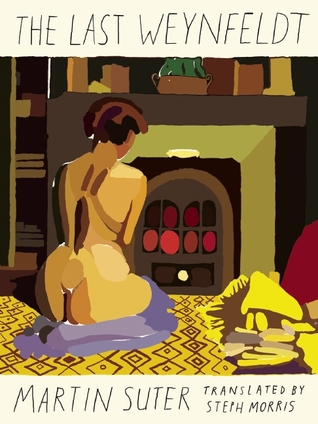
The Last WeynfeldtNew Vessel Press will publish the English translation of this book in February of 2016, but the book was so good that I couldn’t wait that long to review it.  The central figure of the book, Adrian Weynfeldt, is just what the title suggests: he is the last of his family and he is not married and has no children.  Adrian’s parents had him later in life and when they died they left Adrian an extensive inheritance which includes two buildings that are prime real estate in Zurich.

Fifty-year-old Adrian lives alone on the top floor of one of his opulent buildings.  His massive apartment is filled with costly art work and antique furniture.  Because of his family’s wealth Adrian doesn’t have to work, but he does because he loves his occupation as an expert art historian for an auction house in Zurich.  The descriptions of various artwork and the process of art auctions is a fascinating aspect of the book that captivated my attention.

Adrian is mannered to a fault.  He doesn’t ask questions when he should and he is always paying for his friends’ lavish dinners and funding their attempts at careers.  Every Thursday is lunch with his younger friends and Adrian always excuses himself towards the end of the meal and quietly pays the very expensive bill.  Adrian is kind, polite and unassuming and it as very sad to see his so-called friends take advantage of his good nature.

This book is one of those page turners that grabs you right from the first scene.  Adrian is sitting at one of his favorite bars in Zurich when in walks an interesting woman, in her mid-thirties who basically invites herself up to Adrian’s apartment.  He realizes that she is rather intoxicated, so in true Adrian fashion, he feels it would be wrong to sleep with her.  In the middle of the night, Adrian wakes up to find this woman, whose name he figures out is Lorena, standing on his balustrade and ready to jump to her death.  After he talks her off the ledge, Adrian finds that he can’t stop thinking about Lorena even though he doesn’t know very much about her.

It turns out that Lorena has tried to barely squeak out a living by modeling for small companies and catalogues.  She has had a tough life and her latest relationship ended disastrously when she found out her boyfriend had a wife and three children.  Lorena teams up with a small-time con artist named Pedroni and together they decide to try and swindle Adrian out of some of his money.  But Lorena seems to have fallen for Adrian, more so than she is willing to admit to herself, and we are left wondering if she can really cheat him after all.

Adrian and Lorena also become involved in an attempted art forgery and a great part of the suspense of the book lies in wondering whether or not Adrian’s keen eye for art will be able to detect the forgery and stop the sale of this piece before it ruins his career.  But Lorena’s influence has most definitely thrown some chaos into his otherwise ordered and neat life.  The circumstances surrounding the forged art, the sexual tension between Adrian and Lorena and the fascinating character of Adrian himself kept me wondering what was going to happen and wanting more.

I highly recommend that everyone put this on their “to read” pile for 2016.  There are just so many interesting aspects to this story-from the strong characters to the intricate descriptions of art to a mystery of an art fraud.  New Vessel Press has quickly become one of my favorite independent presses and with THE LAST WEYNFELDT they have chosen another fantastic book to bring us in translation.

About The Author:
M SuterMartin Suter (b. February 29, 1948, Zürich) is a Swiss author. He became known for his weekly column Business Class in the Weltwoche newspaper (1992–2004), now appearing in the Tages-Anzeiger, and another column appearing in “NZZ Folio”. Suter has published seven novels, for which he received various awards. He is married and lives in Spain and Guatemala.


8 Comments

Filed under German Literature, Literary Fiction, Literature in Translation

Review: Rendezvous in Venice by Philippe Beaussant

I received an advanced review copy of this title from Pushkin Press through NetGalley.  This title was originally written and published in French and the translators of this English version are Paul Buck and Catherine Petit.

My Review:
Rendezvous in VenicePierre has been an assistant to his uncle for fifteen years, learning about art and the world’s famous masterpieces.  His uncle Charles is very meticulous about his work as an art history professor as he catalogues and studies the portraits of famous artists from all over Europe.  Pierre is Charles’ only surviving relative and, as far as Pierre is concerned, Charles never had much of a personal life or any significant romantic relationships.  Pierre’s knowledge about the life of his uncle all changes when his uncle dies and Pierre finds a very personal diary among his uncle’s private papers.  This diary includes the intimate details of Charles’ affair when he was a middle-aged man with a woman named Judith; one of the highlights of their relationship is a trip to Venice where they have intricate discussions about Italian art.

The elegant writing of the book really drew me in and I read over half of it in the first sitting.  The first part of the book alternates between Charles’ diary and Pierre’s thoughts about his uncle’s secret love affair.  Beaupassant makes us contemplate how well we really know those who are supposed to be closest to us.  Pierre worked side by side with his uncle for years and never knew about such an important aspect of his life.  Pierre wonders how long they were together for and why his uncle never mentioned what must have been a heartbreaking love affair. While Pierre is still contemplating his uncle’s secret, he meets Judith at an art history conference.

It is clear from Pierre’s memories of his uncle and from Charles’ own diary that Charles chose to reject love and lead a solitary life and dedicate himself to his work.  Pierre seems to be moving in the same direction of loneliness until he meets Judith and her daughter, Sarah.  Will Pierre, unlike his uncle, choose love and contentment and happiness or will he continue on as a bachelor for the rest of his life?

I must mention that there are several detailed discussions about painting, and portraiture in particular, that gave me a better appreciation for some famous masterpieces; I enjoyed their descriptions so much that I actually looked up the ones that are mentioned in the book (I won’t mention them here to keep potential readers in suspense). Discussions of art, a venetian setting, and a hidden love affair all combine to make this a lovely French novella that I thoroughly enjoyed and highly recommend.

About The Author:
Philippe Beaussant is a prominent and award-winning French musicologist and writer. Born in 1930, he is a founder of the Centre for Baroque Music at Versailles and a Member of the Académie Française. Beaussant has written numerous books on the history of Baroque art and music, as well as several novels. He has won many awards, including the Grand prix du roman de l’Académie française for his novel Heloise.

6 Comments

Filed under France, Literature in Translation, Novella

Review: Don’t Try This at Home by Angela Readman

I received an advanced review copy of this title from And Other Stories.  They are a small not-for-profit literary press with am impressive selection of books.  Please visit their website for a complete list of great titles: andotherstories.org

My Review:
Dont-Try-This-at-Home-_-cover_-FINAL1-300x460This is a quirky, bizarre collection of tales that also deal with serious social topics.  Child custody, divorce, and gender issues are all explored with an accompanying twist of magic or fantasy.  In one story a mum who works at a chip shop is tired of her mundane life; it is only when she transforms herself into a hip-shaking Elvis that she feels happy and fulfilled.  This story is an interesting commentary on gender identity and the ways in which we suppress our true selves when we try to conform and fit in.

Some of the stories seem downright absurd.  In the title story, “Don’t Try this at Home ”  a woman wants to spend more time with her husband, so she chops him in half.  When the couple needs more money, she chops him in quarters and eighths so he can work more at various jobs.  When one of his other halves has an affair the woman has mixed feelings about her decision to chop up her husband into so many different persons.

I particularly enjoyed the last three stories.  They featured individuals that are misunderstood by their family, friends and neighbors.  In “Keeper of the Jackalopes,” a man lives in a run down trailer with his six-year-old daughter and taxidermies animals for a living.  Business has been very slow so they rely on food tossed into dumpsters behind grocery stores for their meals.  The loyalty that the little girls shows towards her father is very touching and it is this little girl’s advice at the end of the story that helps him deal with some sad issues in his life.

DON’T TRY THIS AT HOME is a fantastic and entertaining group of stories with memorable characters.  I highly recommend that you add this collection to your summer reading list.

About The Author:
Angela-Readman-_Photo-by-Kevin-Howard-460x250Angela Readman’s stories have appeared in a number of anthologies and magazines, winning awards such as the Inkspill Magazine Short Story Competition and the National Flash Fiction Competition. In 2012 she was shortlisted for the Costa Short Story Award for ‘Don’t Try This at Home’ – an award she would go on to win in 2013 with the story ‘The Keeper of the Jackalopes’. Readman is also a published poet.


5 Comments

Filed under Art, Humor, Literary Fiction, Short Stories

Review: Love Maps by Eliza Factor

I received an advanced review copy of this book from Akashic books through Edelweiss.

My Review:
Love MapsSarah is an artist living in New York City in the 1980’s.  Even though she gets her own show at a New York gallery, she is always living in the shadow of her older sister, Maya, who is not only a famous singer but has also made a name for herself as a real estate tycoon.

Maya is self-centered and she is not a likeable character from the beginning of the story.  She seems focused on outward appearances and receiving constant attention and applause. Her disingenuous nature comes through even when she is trying to take an interest in Sarah’s life and career.  Sarah follows Maya around the world organizing the details for Maya’s singing engagements.

Maya is all set to go to Europe for an extended tour, but Sarah tells Maya that she wants to stay in Manhattan and finish a series of paintings which she has been hard at work on.  But when Sarah decides, for once, to put her own career first, Maya has a violent and outrageous reaction to Sarah’s decision.  This event foreshadows what Maya will do in the future to break up Sarah’s happy marriage with Philip.

Sarah meets Philip, of all places, at a funeral of a mutual friend.  It takes some time for them to get together in the book because they are both unsure of themselves and lacking in confidence.  But once they are together they have a loving and supportive marriage and the only thing that is a source of discomfort between them is the presence of Sarah’s overbearing sister, Maya.  Philip is not impressed with her opulent lifestyle and dramatic performances and mannerisms.

Philip is one of the few people, if not the only person, whom Maya is not able to impress and put under her spell.  Maya takes this as a challenge and plays a very cruel joke on Philip that ends in tragedy and alters Philip and Sarah’s happy life forever.  Philip is not able to mentally recover and he declares, in defeat, that Maya has won and he leaves New York, Sarah, his job and the life they have made together.  I was upset throughout the novel that Sarah was so passive when it comes to making important decisions; but growing up in the shadow of her sister conditioned her to living this way.  Can Sarah ever escape the grip of her overbearing sibling?

When the book opens, Sarah has a seven-year-old son named Max who has never met his father.  We discover that Sarah never told Philip that he had a son.  Philip has sent Sarah a letter stating that he will be on her doorstep the next day; we are left in suspense until the end of the book wondering if father and son and husband and wife will ever be united.

LOVE MAPS is a quick and absorbing read that deals with love, relationships, and art and I highly recommend this brief yet intense novel.  I have to admit that when I flipped to the last page I was disappointed that the story had ended.

About The Author:
ElizaFactor-131x200ELIZA FACTOR is a writer and the founder of Extreme Kids & Crew. She lives in Brooklyn, New York, with her husband and three children. Her debut novel, The Mercury Fountain, was published in 2012. Love Maps is her latest novel.

Leave a comment

Filed under Literary Fiction