
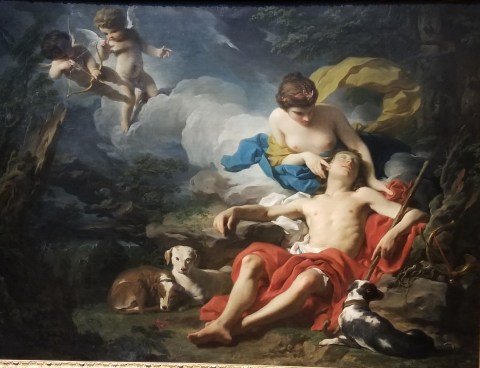
Diana and Endymion. by Pierre Subleyras. 1740 Oil on Canvas.
When visiting a large museum like The Met or a gallery as immense as The National Gallery my habit is to wander though the collections and see what catches my eye. During my recent visit to The National Gallery while I was in London, I kept circling back and spending time with Pierre Subleyras’s painting of Diana and Endymion. The image reminded me of Ovid and his various descriptions of transformations in the Metamporhoses, especially as they relate to the theme of love. There are many variations of the myth, but I suspect Subleyras had in mind the version in which Endymion is an Aeolian shephard who captures the attention of the goddess Diana. What makes the story particularly striking is that Diana is a virginal goddess but her attraction to Endymion overrides her proclivity for solitude. (It is even said in one myth that the couple bear fifty daughters.) Diana asks Jupiter to give Endymion eternal youth and he is also placed in a cave where Diana can visit him every night and admire him in his sleep which is her favorite way to view him.
I find it fascinating that Ovid doesn’t include this story as part of the Metamorphoses, but instead writes a few poignant and striking lines about Endymion in Heroides XVIII. Ovid composes a letter from Leander, a young man who sneaks out of the house at night to swim the Hellespont so he can be with and make love to a young woman named Hero. Hero, a devotee of Venus, lives in a tower and lights a lamp each night for Leander so he can find his way to her. As Leander is reminiscing about his noctural swims, he invokes the image of Endymion and Diana (translation of Heroides XVIII.57-66 is my own):
No more delay, instead I threw off my clothes
along with my fear and I launch my pliant
arms through the liquid sea. The moon, like a
dutiful companion along my path, was offering
her trembling light to me as I was gliding along.
And I, looking up at her, said, “May you,
oh shining goddess, support me and may the
rocks of Latmos rise up in your mind. Endymion
does not allow you to be severe in your heart. Turn
your face, I pray, to help me in my secret love. You, as
a goddess, glided down from heaven to seek a mortal
love. May it be permitted for me to speak the truth!—-
The woman whom I pursue is herself a goddess.
As I am drawn back again and again to that peaceful look on Endymion’s face in the Subleyras painting, I can’t help but think that he must have been a soothing presence for Diana. As I contemplate the painting in relation to both of these myths, their many parallels make themeselves evident; if Diana wouldn’t let a little thing like mortality stand in the way of love, then Leander can’t let geography or the sea impede his way either. If only Endymionis somnium dormire (to sleep the sleep of Endymion.)
For the extra curious, here is a link to the Latin text: http://www.thelatinlibrary.com/ovid/ovid.her18.shtml

 The stereotypes of country dwellers being crass and uncouth and city dwellers being urbane and sophisticated is one that reaches all the way back to Ancient Rome. In Carmen 22, Catullus describes his good friend Suffenus whom he admires for being venustus et dicax et urbanus (charming, well-spoken and sophisticated). The Latin word urbanus, from which the English word urban is derived, literally means a person from the city who is sophisticated. But Catullus sadly notes that Suffenus is an awful poet and when one reads his compositions he appears to be caprimulgus aut fossor (a goat herder or a ditch digger) and he is infaceto est infacetior rure (duller than a dull hick). Rus, ruris becomes in English the word rural which is associated with someone who lives in the countryside and is decidedly unsophisticated.
 At the beginning of Book Three of War and Peace, Tolstoy writes about the laws of historical movement: “Only by taking an infinitesimally small unit for observation (the differential of history, that is, the individual tendencies of men) and attaining to the art of integrating them (that is, finding the sum of these infinitesimals) can we hope to arrive at the laws of history.” Throughout his many commentaries on history in War and Peace, the author rejects the idea that it was a single great man, like Napoleon or Alexander I, that caused the French invasion of Russia and the army’s resulting destruction. The entire second epilogue, for instance, is dedicated to Tolstoy’s thoughts on the study of history as he explores concepts like liberty, grandeur, power and religion and how they come to bear on the examination of past events; it is a shame that many don’t read this section and that it is not included in certain editions of the English translations. As I reflect on the work as a whole, two of Tolstoy’s themes keep coming to mind: war and love. He examines both of these subjects on a grand scale but it is equally important for him to focus his text on the lives of individuals, getting down to the level of the “infinitesimals.”


 The Book Binder's Daughter