 There are just certain books that change you. After spending the last month reading all 1557 pages (excluding notes and index) of Reiner Stach’s biography of Kafka, I will never look at the author, his writings, the early 20th century, marriage, Prague, Zionism, biography, friendship or World War I the same again. For my readers who are used to my relatively short posts, I apologize for this rather lengthy piece of writing. I felt that Stach’s profoundly enlightening book and Shelley Frisch’s meticulous, thoughtful translation of it required more time and attention to capture the depth and complexity of all three volumes when viewed as a whole.
Although I read Stach’s comprehensive and astonishing three volume biography of Kafka in chronological order, this was not the order in which they were written and published. Stach was waiting for access to the extensive papers in the literary estate of Max Brod, which were hung up in years of litigation, in order to finish writing the first book about Kafka’s earliest years. Thus it is in the second volume, The Decisive Years, which was released first, where we find Stach’s eloquent introduction to the entire project. He describes the onerous task of writing a biography of Kafka:
Most biographies, even the best among them, are composed in this way, through a kind of honeycomb technique. The picture of how a life was lived breaks down into a number of thematic segments, each of which is relatively independent of the others and calls for separate research: background, education, influences, achievements (or misdeeds), social interactions, religion and political and cultural background. Ultimately some interdependences blur this initially clear picture, but if the biographer does not want to subject readers to a hodgepodge, the fiction of topical clarity must be maintained, each subject must be synthesized separately, each cell of the honeycomb must be closed. Only then, in a second step, will the biographer try to merge the cells in such a way as to minimize the empty spaces: a synthesis of syntheses. The result is a portrayal of a life whose events are narrated in linear fashion, their causal connection thus made evident. The honeycomb cells lie in a row, and the conceptual paradigm of this kind of biography is the journey through life.
Kafka, born into a Jewish family in Prague at the end of the 19th century, was named after Franz Joseph I, the kaisar of the Austro-Hungarian Empire. He was survived by three younger  sisters who were all murdered in concentration camps by the Nazis during World War II. He earned a doctorate in law, but had no intention whatsoever of being a lawyer. He was excellent at his job at the Worker’s Insurance Institute and wrote many legal documents that advocated for workers’ safety. He had a strained relationship with his father to whom he wrote a 100-page letter but which he never delivered. When he broke up with his fiancé, Felice Bauer, for the final time he went to his best friend Max Brod’s office and sobbed uncontrollably. He desperately wanted to join the fight in World War I, but his employers kept exempting him from service. After Felice, he was engaged for a second time to a woman named Julie with whom he broke it off when he met Milena, a Czech journalist who lived in Vienna. Milena’s pet name for him was “Frank.” Shortly after being diagnosed with tuberculosis, he also came down with a horrible case of the Spanish flu which he miraculously survived. He loved swimming, going to the movies and slapstick comedy. He, himself, had a droll sense of humor. He was a naturalist and a vegetarian and enthusiastically took up an interest in gardening. He was not a practicing Jew, but towards the end of his life he developed a renewed interest in Jewish culture and history and learned Hebrew. When he lived in Berlin, he would put on a suit and tie every day to go out and buy his milk. He was shy, introverted and brooding but he was also kind, empathetic and generous. In the last, painful days of his life his laryngeal tuberculosis prevented him from speaking, eating and drinking and his only communication was done by writing on slips of paper. He requested on one of these notes to a friend that he be given some ice cream to try. When he awoke on June 3rd, 1924 in excruciating pain and could not breath, he asked his friend, a physician, Robert Klopstock to euthanize him with morphine. Klopstock did give him a dose of an opiate, but we are not sure how much. Dora Diamant, the third and final woman to whom he proposed marriage, held his hand and consoled him with the smell of his favorite flowers as he died.
These are, to me, some of the most surprising and enlightening bits and pieces of these honeycomb cells that Stach constructs throughout the course of his extensive biography. Stach argues that Kafka’s struggled with the same issues throughout his life and though there are only a few themes on which to focus—marriage, family, literature— each one of these threads can be connected in a complex number of ways. Kafka’s views on marriage, for instance, can first be analyzed in light of his parents’ own union which took place with the help of a professional marriage broker. Stach describes in The Early Years how Hermann Kafka decides that he is in need of a Jewish bride with a decent dowry who could co-manage his fancy goods store and that’s exactly what the professional matchmaker finds for him in Julie Lowy. Love, in the very beginning at least, has nothing to do with it. As a Jewish man who grows up in a petit bourgeois family, in Prague, at the beginning of the 20th century Kafka has certain expectations placed on him as far as marriage is concerned. He has to be a good provider, his wife has to have a spotless reputation, the dowry has to be the right amount, and, most importantly, his family has to approve of the match.
 And, of course, a thorough discussion of Kafka’s views on marriage also requires Stach to look into the marriages of Kafka’s closet friends. Kafka’s best friend, Max Brod, was a notorious womanizer and even when he finally decides to settle down into marriage, he still has numerous affairs with women in different cities to which he would frequently travel. Kafka appears to have known all of the nitty gritty details of Brod’s amorous adventures and even becomes friends with some of Max’s lovers, which makaes seeing Max’s wife rather awkward. Oscar Baum, a fellow author and music teacher, seems to have a happy marriage but he is heavily dependent on his wife for many of his needs because of his blindness. Kafka is also a witness to Felix Weltsch’s marriage which is a bad match and a miserable disaster from the beginning.
Although there appears to be a dearth of happy marriages for Kafka to emulate, he very much wants to get married, but on his own terms. He rejects the traditional expectations placed on him and wants a union that will be both emotionally intimate and physically fulfilling. He envisions a domestic partnership in which he and his future wife will have common interests and he particularly wants his wife to share his passion for literature and to support his writing. His biggest fear in marriage is that a wife and family might hinder his writing and intrude on the solitude he required to carry out his work.
As I was reading Stach’s various threads about Kafka’s views on and attempts at marriage I kept thinking about some advice I received once from a dear, kind friend (who, like Kafka, is a great correspondent) about marriage. He wrote: “I was reading a book by a member of the Clapham Sect recently and was struck by this passage: ‘Nothing so soon, and so certainly wears out the happiness of married persons, as that too common bad effect of familiarity, the sinking down into dullness and insipidity; neglecting to keep alive the flame by the delicacy which first kindled it; want of vigilance in keeping the temper cheerful by . . . discipline, and the faculties bright by constant use. Mutual affection decays of itself, even where there is no great moral turpitude, without mutual endeavours, not only to improve, but to amuse.’ The idea of making an effort to amuse and entertain one’s spouse is certainly unheard of these days. But I do think the point of the passage is a good one. Marriage should be deliberate, and if it is deliberate, it can be fun.”
My friend’s thoughts are not new—he brings up age old questions—why do we marry and when we choose a partner, what keeps us in that marriage for the long-term? How do we know when it’s over and when do we decide that things are hopeless and the only option left is to leave? Stach keeps circling back to all of these questions that consume Kafka throughout his adult life. In Kafka’s letters to Felice, some of which I think are didactic in tone, he constantly talks about literature, what he is reading, what she is reading, what he is writing. He so desperately wants her to be a part of his literary life and the illusion that she is capable of doing this for him is a big part, I think, of what keeps him from breaking it off with her for five years. In their later correspondence he encourages her to volunteer at a Jewish Home for children, a common cause, he thinks, that they can develop together. He is always searching for that mutual endeavor and he never quite finds a satisfactory one to share with her. Their engagement party in Berlin is described by Kafka as anxiety inducing, he feels suffocated and the event has more of the tone of a funeral, an ending for him, than a beginning of a new life.
With Milena, who was a writer and a journalist, Kafka seems to have found this mutual endeavour in literature and in a physical attraction but she could never break free from her tumultuous marriage. He seems to have learned his lesson with Felice that a prolonged, hopeless relationship will only waste his time and cause him more anxiety. He is much more decisive and quicker to break things off with Milena. Finally, Kafka meets Dora, with whom he has several mutual endeavours—literature, Zionism, Jewish history and Culture, a physical and emotional intimacy he had always craved. And, what I think is most important, is that their affection for one another is very deliberate, especially under strained circumstance. Dora takes such tender and devoted care of Kafka when his tuberculosis is becoming worse, and despite the fact that his health is poor he moves away from his family to be with her in Berlin. Just at the time when he finds the perfect partner, his life is cut short. It is nice to think that their relationship would never have sunk down into dullness and insipidity. But who knows…
Stach continually points out in his narrative that an examination of Kafka’s views on marriage are also closely related to his writings—the greatest and best source for his relationships is his own writings in the form of letters and diary entries. In addition, many of Kafka’s short works deal with marriage, family and bachelorhood. Stach meticulously and deftly connects both of these thematic threads, these “honeycombs” at several points in the biography. Many scholars have attempted to track down and comment on every piece of autobiographical information that Kafka weaves into his writing. Stach argues that this is exhausting, and futile, and doesn’t necessarily give us more insight into Kafka’s stories. Instead, Stach focuses his attention on Kafka’s most productive time periods and shows that the more pressure and anxiety that is placed on him the more productive he becomes.
By placing Kafka’s novels and short stories in the broader context of what is happening in his life, Stach’s discussion of Kafka’s body of literature proved invaluable for me. For example,  “The Judgement” which I had read only once and has never really stood out in my mind among Kafka’s writings, was considered by the author his best piece of work. He writes it in a single, sleepless night after he meets Felice. After reading this entire biography, I understand better why animals, frustrating government officials, and feelings of helpless and despair abound in Kafka’s writings. The most enlightening chapters for me as far as Kafka’s writings are concerned are those in which Stach guides us through the process and circumstances under which all three of Kafka’s novels remained unfinished. I assumed because he died young he never had time to complete any of them. But after reading Stach’s thoughts on The Castle, Amerika, and The Trial I am now of the opinion that even if he lived another 40 years these books would not have progressed much further. Kafka’s crippling self-doubt, his nagging sense of perfection and a myriad of other circumstances which caused him to endlessly dither would never have gone away.
Finally, Stach’s treatment of marriage and literature are also closely connected to his analysis of Kafka’s relationships with friends and family. Stach, once again, is always attempting to attach these honeycombs. For example, a great deal of information we know about Kafka’s early years is from the author’s 100-page letter to his father and Stach quotes the letter extensively in the first volume. Hermann Kafka was an authoritarian patriarch who yelled often and berated his son for his perceived failings and inadequacies. Kafka’s bachelorhood must have irritated Hermann to no end and been a constant source of tension at the family dinner table. Marriage and his failure to go through with one was another topic that Kafka brings up in his letter to his overbearing pater familiae.
Kafka has one of his most productive periods during the final winter of World War II despite cold and starvation, in large part due to his sister Ottla’s providing a comfortable place for him to write and tending to all of his needs. He also writes in the famous Blue Octavo Notebooks during this phase. In the end, even though he had his issues with his intrusive, pushy family, they support him financially when his illness is at its worst. He composes a lovely, tender and heartbreaking letter to both of his parents the day before he dies. Although he could be shy, brooding and introverted, his kindness and empathy attracts the best and most loyal friends. Most of what he publishes during his life was done through the efforts and interventions of Max Brod. It was Max who travels from Prague to Berlin to escort Kafka to the proper hospital to get the medical treatment he so badly needs at the end of his life. And, of course, it is Max we have to thank for saving and publishing the vast amounts of letters, diaries and manuscripts that Kafka left behind. Everyone ought to have a true friend like Max.
In hindsight Kafka’s life is judged as a success because of the wide and enduring popularity of his literature. But after reading Stach’s magnum opus, I think that a better measure of a good and successful life is the kind of love and respect we receive from the types of people with whom we surround ourselves. Stach’s depictions of people like Max, and Robert Klopstock, and Ottla, and Dora and their interactions with Kafka are full of love, tenderness, mutual admiration and respect; I would say that his short life was indeed rather successful. Stach has forever altered my view of Kafka for the better.

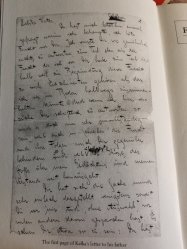 In the Fall of 1919, Kafka takes a two week vacation from his job at the Insurance Institute and spends it alone at an inn in Schelesen. His sole purpose for this time off is to write a letter to his father, what he himself calls a “legal brief”, that will serve as a thorough and frank description of their strained and contentious relationship. Kafka tried on previous occasions to broach the subject of his father’s awful behavior towards his children, but none of the letters he drafted were this comprehensive. Hermann Kafka’s constant verbal abuse of Kafka’s youngest sister, Ottla, in regards to her choice of suitor and profession, seems to have been one of the major catalysts for this epistolary undertaking. One of the recurring themes of the letter is fear, and that’s where Kafka begins (trans. Kaiser and Wilkins):
 I have reached one of the parts of Stach’s biography that I been eagerly anticipating—his discussions of Kafka’s Blue Octavo Notebooks. In the winter of 1916-1917, Kafka’s youngest sister, Ottla, rents a small house in Alchimistengasse (Alchemists’ Alley) in a section of Old Prague. “A room with an open hearth in a tiny basement, grimy and dilapidated, for a mere twenty kornen,” Stach says. Ottla rented it in secret and it was to serve as a little oasis, away from her parents, away from the family shop, for a few hours a day. She generously shared her space with her brother and Kafka loved the quiet and solitude of this space; while visiting this simple hideaway, at the height of winter and world war, he had one of his most productive writing periods. During this time, Kafka started writing in octavo notebooks instead of his diary. As usual, Stach’s description of these notebooks is perfect:



 The Book Binder's Daughter