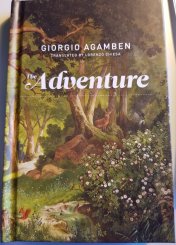
The Adventure by Giorgio Agamben

Macrobius was a Roman grammarian, philosopher and author who lived and produced his most important work, the Saturnalia, in the early part of the 5th century A.D. The Saturnalia is a symposium, a conversation among friends, that takes place on the day before and three days during the Saturnalia, the festival dedicated to celebrating the harvest and the Roman god Saturn. The conversation encompasses a wide range of topics that include religion, literature, philosophy and rhetoric. In Book 1, a dinner guest describes the Egyptian belief that four important deities preside over the birth of every human (this translation is my own):

The Egyptians explain the significance of the Caduceus at the begetting of all humans, which is called genesis, by saying that there are four gods present at the birth of each person: Daimon (Spirit), Tyche (Chance), Eros (Love), Ananke (Necessity). The first two they wish to be understood as the sun and the moon, because the sun is the source of spirit, heat and light and both the procreator of human life and its guardian, and thus it is the Daimon or the deity of a person being born; the moon, however, is Tyche, because she is the guardian of bodies which are thrown about by the varieties of fortune. Love is signified by a kiss; nesessity is signified by a nod.

Giorgio Agamben, in his latest short philosophical work entitled The Adventure (trans. Lorenzo Chiesa), borrows these four gods from Macrobius to build his discussion and definition of the word “adventure.” And following the example of Goethe, who, in his Urworte, adds Elpis (hope), Agamben translates these deities as Demon, Event, Love, Necessity and Hope. He writes, “Every human is caught up in the adventure; for this reason, every human deals with Daimon, Eros, Ananke, and Elpis. They are the faces—or masks—that adventure—tyche—presents us with at each turn.” Agamben argues against the modern definition of adventure, which is seen as an event that is strange and out-of-the-ordinary, and wants to replace it with a more universal term that corresponds to our everyday Being and experience in the world. “The idea that adventure is something external—and therefore eccentric and bizarre—with respect to ordinary life defines its modern conception,” he asserts.

Agamben begins, as usual, with the history and etymology of the word “adventure”; previous authors have argued that the term comes from the Latin advenio as the neuter, plural, future, active participle—adventura. But, Agamben points out, there is no proof of its use in Classical Latin. He concludes, “Whether it derives from the classical and Christian Latin adventus (the advent of a prince or a messiah), as is likely, or from eventus, as the late Du Cange suggested, the term designates something mysterious or marvelous that happens to a given man, which could be equally positive or negative.” And in the love poetry of the troubadours, adventure is used to describe not only the event but also the story that is told about the event:

The aventure (or aventiure) may be marvelous or fortuitous (in which case it means “chance”), beneficial or malefic (one will then call it bonne or male aventure; the term seems to be equivalent to “fate” or “fortune”), or more or less perilous (it will thus stand as a challenge to the knight’s courage); however, it is not always easy to distinguish between the event and its transposition into words.

It is this medieval idea of adventure towards which we ought to return, Agamben argues. In the next two chapters he elaborates on the influence that Eros (Love) and Tyche (Event) have on the concept of adventure. Eros is the very thing that gives life to the demon, it is Eros that drives us to abandon ourselves to the adventure and the event without reservations. Eros and adventure are intertwined “..not because love gives meaning and legitimacy to adventure, but, on the contrary because only a life that has the form of adventure can truly find love.” And, as far as the event is concerned, “Not only are the event and speech given together in the adventure but—as we saw—the latter always demands a subject to whom it must be told.” A refreshing, hopeful, even playful definition of adventure emerges from Agamben’s essay. In the concluding chapter, Elpis (Hope), is the concept that links all of the other ideas together. But this is not the modern concept of hope from silly Internet memes or self-help gurus; it is more immediate, in the here and now, the hope that affects the essence of our Being daily: “Just as hope overcomes its satisfaction, so too does it surpass salvation (and love).”

I have read this delightful book a few times since last week and one thing that has bothered me about it is the translation of the Ancient Greek word daimon as “demon.” Although it can be used as an alternative for “daemon” (a spirit or numen), demon, in the monotheistic, Christian sense, has a decidedly negative connotation as something evil. In Ancient Greek daimon is used to denote a spirit in relation to a deity, and can also be translated as “power” or “fate”. Macrobius’ description, cited above, of the Egyptians belief that it is the source of heat, light and a guardian for humans at birth is very similar to the Ancient Greek understanding of it. (I’ve discussed the word daimon more thoroughly elsewhere in the context of Ancient Greek tragedy in a review of Anne Carson’s translation of Euripides Bakkhai.) Agamben is arguing that this spirit, this Being, present at birth is the every day, driving force behind adventure. Maybe I am mistaken, but it seems that an English speaking audience would automatically assume that demon is used in the negative, Christian context. I don’t have access to the Italian text, but I wonder what the word for daimon is in Italian and if it is closer to the original Ancient Greek meaning? Perhaps it would have been more beneficial for the sake of his argument if the translator used the Latin word daemon or, better yet, left it untranslated as daimon?

12 Comments

Filed under Italian Literature, Literature in Translation, Philosophy

The Vital Force of the Kore: The Unspeakable Girl by Giorgio Agamben and Monica Ferrando

The Ancient Greek goddess Demeter (Ceres to the Romans) was associated with the harvest and agriculture and was worshipped at her temple in Eleusis.  The Homeric Hymn to Demeter tells us that the goddess has a daughter, Persephone or Kore, fathered by Zeus, who was abducted by Hades and forced to live in the underworld with her husband for part of the year.  The story of Demeter and Persephone can be viewed as a nature myth—Persephone represents the seed, planted under the ground and fertilized by Zeus, that grows in the spring as the harvest and whose maturity is represented by Demeter herself.  The story can also be viewed as an etiological myth whereby the seasons are explained—the months in which Persephone spends with her husband in Hades Demeter does not let anything grow and thus it is winter.  Finally, the story of Demeter can be viewed as a charter myth that explains the origins for the rituals that take place during the Eleusinian Mysteries at the temple of Demeter.
During the autumnal celebration of the Eleusinian Mysteries, which were organized by the Athenian polis, there were rituals that involved fasting, a procession with sacrificial pigs, purification in the sea, and the consumption of a sacred drink.  The nocturnal procession went from Athens to the Temple of Demeter at Eleusis where initiates would gather in the Hall of Initiations, the Telesterion, where the hierophant (sacred revealer) revealed the “holy things.”  It was said that Demeter bestowed two gifts to her initiates: a stalk of grain and the mysteries that were said to hold a promise to a happier afterlife.  The mysteries that took place at the annual celebration were kept secret by all participants.

In his essay, The Unspeakable Girl,  published in English by Seagull Books and translated by Leland De La Durantaye and Annie Julia Wyman, Italian philosopher and author Giorgio Agamben begins with a discussion of the Ancient Greek word Kore.  Agamben’s writing is challenging but of the few things I read so far, he begins with the etymology of important words, which makes his narrative, for me, more accessible.  He writes:

The Greek term kore (masculine form: koros) does not refer to a precise chronological age.  Derived from a root meaning ‘vital force’, it refers to the principle that makes both plants and animals grow (koros also means ‘offshoot’ in the botanical sense.)  A kore, can thus be old, like the Phorcydes, called denaiai korai, the ‘long-lived girls’ and the graiai, ‘those with white hair.’ Aeschylus calls the terrifying avengers of blood crime Erinyes (or Furies), korai, as well as graiai palaiai pades (ancient children with white hair.)

Agamben concludes that “Kore is life in so much as it does not allow itself to be ‘spoken’, in so much as it cannot be defined by age, family, sexual identity or social role.”  The philosopher uses this idea of Kore as the unspeakable for a further discussion of the mysteries involving Demeter and Kore that take place during the Eleusinian rituals.  His thesis is that the mystery is not so much a sacred object that is revealed or an event that happens during the ritual, but a mystical transformation which the initiates experience that is unspeakable—not unspeakable in the sense that it is prohibited to be spoken about but in the sense that there is no language that adequately expresses the experience.  Agamben cites and discusses key passages from Aristotle and Plato who describe the acquisition of philosophical knowledge as a mystic experience or initiation.  Agamben concludes, “When she was abducted by Hades, Kore was ‘playing (paizousan) with the girls of Ocean’ (kouresi syn Okeanou; Homeri Hymnus in Cecerem 5.5).  That a girl at play became the ideal figure for the supreme initiation and the completion of philosophy, the figure for something that is at once thought and initiation and thus unspeakable—this is the ‘mystery.'”

And why should the modern reader care about initiation into ancient mystery cults.  This is, perhaps, my favorite part of Agamben’s argument; he makes this ancient thought and practice relevant to a 21st century audience: “Whether it be Lucius in The Golden Ass or Isabel Archer in Henry James’ Portrait of a Lady, the novel places us before a mysterion to which life itself is at once that which initiates us and that into which we are initiated.”

“The goddess threw herself like a maenad down the woody mountainside.” Pastel on recycled paper. Monica Ferrando.

This Seagull edition also includes gorgeous paintings by artist Monica Ferrando as well as her translations of Ancient Greek and Latin text sources for Demeter, Persephone and the Eleusinian Mysteries.


1 Comment

Filed under Classics, Italian Literature, Literature in Translation, Philosophy

Love is Not Blind: A Renaissance Love Elegy by Cristoforo Landino

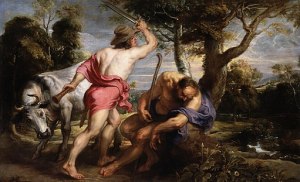
Mercury slays Argus while he is guarding Io. Peter Paul Rubens. 1636-1638.

The Italian Renaissance scholar Cristoforo Landino (1424-1498) is best known for his philosophical dialogues written in the vernacular Italian of which he was an advocate.  But, in the style of Latin love elegy—Catullus, Ovid and Propertius—he did compose a series of poems about his love affair with a woman he tenderly calls Xandra.  In the following poem entitled “Conqueritur de Amore” (Complaints about Love) he vehemently dismisses the commonly held notion that love is blind (translation is my own):

Alas, whoever believes that Love is blind is indeed deceived: Argus, the ferocious monster, didn’t have as many eyes in his head as my lover! For what shadows or what out-of-the-way places are able to secretly snatch me away in safety from her eyes? The riverbanks and the rivers overflowing their curved banks and the leaf-covered fields are my witnesses, for it is among them that, desiring to put aside my shameful, fiery passion, I have sought to complain pointlessly about the savage lashings of my mistress. For you, oh wild beasts, have often seen me wandering around among your mountains in a vain attempt to hide myself. And what have I accomplished? That cruel god, Cupid, never guides his path away from my heart. Are there no other mortal hearts for you to burn with your little torches? Or what about immortal hearts? Or do you prefer to safely relax with your fellow deities with whom you’ve made a sacred pact? You are certainly sure to tire out those bloody weapons of yours as I now stand in resistance. But your bow only holds me in its sights. Go ahead and lead forward, you three Fates, you savage spirits, your distaffs that you have imposed upon us so harshly; I just pray that there is a limit and an end to my madness. There is no limit for a grand love. But my Xandra knows what your quiver is capable of, she knows full well about adverse love. Although she might be capable of conquering fierce tigers and Sicilian giants or conquering Harshness itself, she nevertheless does not look at my wounds with dry eyes. My girl is indeed harsh, but she is not that hardhearted.

This poem is particularly indebted to Ovid for its mythological allusions to Argus and Cupid; Ovid is fond of calling the amorous god “savage boy.”  I especially like that, although the poet is trying to hide from all seeing eyes of his love, in the end he playfully acknowledges that she does have a soft spot for him and he for her.

4 Comments

Filed under Uncategorized

Not Dead, But Frozen into their Attitudes

Nothing excites me more than studying, researching and pondering etymology, derivatives, word usage, etc.  This little gem, from Owen Barfield’s book  History in English Words, was waiting for me in my inbox when I woke up this Sunday  morning.  It is not enough for me to copy into my commonplace book,  I had to share:

In the common words we use everyday the souls of past races, the thoughts and feelings of individual men, stand around us, not dead, but frozen intp their attitudes like the courtiers in the garden of the Sleeping Beauty. The more common a word is, and the simpler its meaning, the bolder very likely is the original thought which it contains and the more intense the intellectual or poetic effort which went to its making.  Thus, the word quality is used by most educated people every day of their lives, yet in order that we should have this simple word Plato had to make the tremendous effort (it is one of the most exhausting which man is called on to exert) of turning a vague feeling into a clear thought.  He invented the new word ‘poiotes’, ‘what-ness’, as we might say or ‘of-what-kind-ness’, and Cicero translated it by the Latin ‘qualitas’, from ‘qualis’.  Language becomes a different thing for us altogether if we can make ourselves realize, can even make ourselves feel how every time the word quality is used, say upon a label in a shop window, that creative effort made by Plato comes into play again.  Nor is the acquisition of such a feeling a waste of time; for once we have made it our own, it circulates like blood through the whole of the literature and life about us.  It is the kiss which brings the sleeping courtiers to life.

9 Comments

Filed under Uncategorized

Raised to the Pitch of Incandescence: Memoirs of a Dutiful Daughter by Simone de Beauvoir

“Sartre corresponded exactly to the dream-companion I had longed for since I was fifteen; he was the double in whom I found all my burning aspiration raised to the pitch of incandescence,” writes a young Simone de Beauvoir who is about to begin her most famous love affair.   While reading Memoirs of a Dutiful Daughter, the first in a trilogy of very detailed books about her life, I kept thinking that incandescent, intense, and passionate are the perfect words to describe Beauvoir even from a very young age.

At the age of five or six Beauvoir has vivid memories and intense feelings of love and devotion towards the people who are closest to her: her parents, her younger sister and her nanny, Louise.  She believes they are all perfect and can do no wrong and adores her family with an unwavering and almost romantic fervor.   She writes about her earliest years, “I though it was a remarkable coincidence that heaven should have given me just these parents, this sister, this life.  Without any doubt, I had every reason to be pleased with what fate had brought me.”  When she goes to school she throws herself wholeheartedly into her studies and is very proud when she receives praises and rewards for her academic achievements.  And the young Simone’s religious devotion is just as passionate as her love for her family and her interest in learning:

I was very pious; I made my confession twice a month to Abbe Martin, received Holy Communion three times a week and every morning read a chapter of The Imitation of Christ; between classes, I would slip into the school chapel and, with my head in my hands, I would offer up lengthy prayers; often in the course of the day I would lift up my soul to my Maker.  I was no longer very interested in the Infant Jesus, but I adored Christ to distraction.

As she grows older, she gradually loses her faith and questions the double standards for men and women placed on her not only by the rules of religion but also by the demands of the bourgeois society that she has grown up in. She is discouraged from asking any questions about sex and doesn’t realize until an absurdly late age—at least by today’s standards—how conception takes place and she knows full-well that this is ridiculous.  She detests the idea that it is acceptable for young men to sow their wild oats and have a variety of sexual escapades before marriage, but if  a woman does the same thing then she, and her family, are ruined.

Not surprisingly, Beauvoir goes from one extreme to the next—she embraces atheism, openly rebels against her parents, and chooses education and a career instead of marriage and children.  As she is moving towards these things her desire for more and more freedom causes her a great deal of angst and her moods are rather extreme.  She goes, within the space of a page or two, from being in love with life to being in the absolute pits of despair.  She oftentimes quotes the diary she keeps during these years which are filled with grand, melodramatic statements: “I want life, the whole of life.  I feel an avid curiosity; I desperately want to burn myself away, more brightly than any other person, and no matter with what kind of flame.”

In a lot of ways the memoir is  a tragedy about two of the closest people to her throughout her childhood and her teenage years: her older cousin Jacques and her best friend Zaza.  Beauvoir is intermittently in love with her cousin whom she views as a hero, especially in her younger years.  For a time she even thinks that should could marry Jacques, but her feelings about him, like many other things in her life, run to the extremes of love and rejection.  And Zaza she meets when they are young pupils at the same school.  It is touching to see that as the girls get older they become closer friends and confidants.  But neither Zaza nor Jacques are able to break free from yoke and expectations placed on the by bourgeois life.  While Beauvoir is studying at the Sorbonne, living on her own, and meeting Sartre, her cousin and her best friend are swallowed up by their miserable lives.

This volume of the memoir ends just as Beauvoir is about to take up a love affair with Sartre.  The amount of details, the extremes of emotion, the incandescence are, at times, a bit overwhelming—not that I didn’t like her writing, and, in fact, I oftentimes identified with her.    But I think I will take a break because I am in need of something a little more serene at the moment before I resume her story.

11 Comments

Filed under French Literature, Nonfiction