
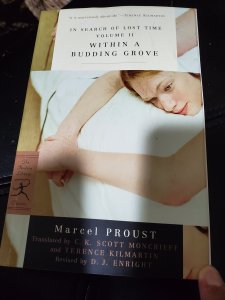
 As a young boy and adolescent, the narrator of Proust’s masterpiece is an avid reader and is a particular devotee of the books of an author called Bergotte. As a consequence Proust gives us some insight into what he thinks about writing, literature and other creative endeavors that require talent and genious. When the narrator meets his hero, he remarks about the author’s style of writing:
The true variety is in this abundance of real and unexpected elements, in the branch loaded with blue flowers which shoots up, against all reason, from the spring hedgerow that seemed already overcharged with blossoms, whereas the purely formal imitation of variety (and one might advance the same argument for all the other qualities of style) is but a barren uniformity, that is to say the very antithesis of variety, and cannot, in the work of imitators, give the illusion or recall the memory of it save to a reader who has not acquired the sense of it from the masters themselves.
Proust has an interesting mix of real and fictional authors throughout his story. For readers and critics who try to understand why Proust invents this fictional author, Bergotte, and, in vain, attempt to guess on whom he is based, Proust provides the answer in his narrative.
And for those who fret over genre, and how to categorize his lengthy, meandering, difficult, masterpiece—to which a countless number of adjectives have been applied in the attempt to label it—Proust offers this:
The reason why a work of genius is not easily admired from the first is that the man who has created it is extraordinary, that few other men resemble him. It is his work itself that, by fertilising the rare minds capable of understanding it, will make them increase and multiply. It was Beethoven’s quartets themselves (the Twelfth, Thirteenth, Fourteen and Fifteenth) that devoted half a century to forming, fashioning and enlarging the audience for Beethoven’s quartets, thus marking, like every great work of art, an advance if not in the quality of artists at least in the community of minds, largely composed today of what was not to be found when the work first appeared, that is to say of persons capable of appreciating it. What is called posterity is the posterity of the work of art. It is essential that the work (leaving out of account, for simplicity’s sake, the contingency that several men of genius may at the same time be working along parallel lines to create a more instructed public in the future, from which other men of genius will benefit) should create its own posterity.
I enjoyed Swann’s Way more than I can appropriately express in a post. The way in which he gives us Swann’s account of his painful relationship with the courtesan, Odette, by taking on Swann’s point-of-view was riveting, to say the least. As I began Volume II, In a Budding Grove, I had expected that in the chapter entitled “Madame Swann at Home” that I would, in turn, get Odette’s point-of-view and learn more about how their marriage came about. But Proust only gives us Mme. Swann’s story through his narrator’s eyes. That’s not to say that he isn’t successful at writing female characters—quite the opposite, in fact. I’ve enjoyed Mme. Swann’s story just as much, if not more, than Swann’s himself. Proust doesn’t, however, dare to step in her place and write from her perspective. Even after 800 pages of text I am still learning from Proust how to read Proust, that is, to throw all expectations I’ve gained from my previous reading out the window.
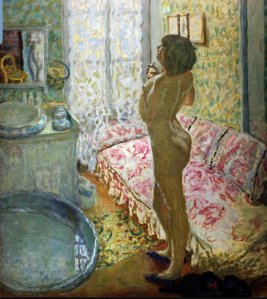
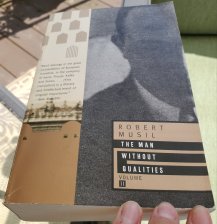 It’s impossible to do any kind of a coherent analysis of Musil’s brilliant, enigmatic, philosophical, unfinished magnum opus. But I thought I would share some final ideas that kept coming to mind as I read Volume II in the Sophie Wilkins translation. It can’t be a coincidence that Musil chose Diotima and Agathe, names from Plato’s Symopsium, for his prominent female characters. Similar to Plato, Musil uses his characters that are sometimes quite serious, and oftentimes ironic or sarcastic to explore the topics of Eros (Love), beauty, goodness and morality. Musil is interested in the passions that are sparked by physical love, but also the beauty and insight that Eros inspires when felt on a deeper level. But none of his characters ever achieve a higher or successful or even contented state of Eros. Diotima and Agathe are both married to taciturn, duty bound and stern men who satisfy them neither physically or intellectually. When Diotima, who is described as a voluptuous beauty with her hair always in a perfect Grecian knot, begins to spend with a Prussian business magnate named Paul Arnheim, her emotional and intellectual connection with him allows her to see the beauty in other things around her.
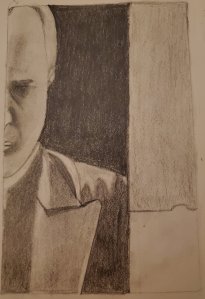 One of the threads that runs throughout Musil’s magnum opus, The Man without Qualities, is the lines that are blurred, especially by those in authority and the media, between truth and opinion. The protagonist, Ulrich, is hired to be a part of the campaign to celebrate the 70th jubilee of Franz Josef’s reign over the Austro-Hungarian Empire and suddenly finds himself coming in contact with the Austrian social, political and economic elites. One such character is not even Austrian, but a Prussian businessman and prolific writer named Arnheim whose celebrity status outweighs the fact that he is not from the mother country yet is helping to plan a nationalist campaign to celebrate Austria. The media adores this man of industry, a veritable Renaissance man who is able to discuss and be knowledgeable on just about any topic. When the Austrian media is supposed to be covering the Austrian campaign to celebrate its Austria emperor, it is Arnheim, the Prussian, that most interests them. Musil’s commentary on the situation is clever, witty and still relevant 100 years later:
 I’ve spent the last couple of days immersed in Musil’s enormous, 1,400 plus, two volume, unfinished Magnum Opus and have been completely drawn in and captivated by his writing. My reading experience reminds me, so far, of War and Peace, which I devoured the winter before last in a matter of three weeks. Musil constantly switches his narrative back and forth among different characters, buildings layers of interest through his third person point-of-view. He starts, of course, with his main character, Ulrich—the very man without qualities—and then gives us portraits of those with whom Ulrich has contact, from the maid of a distant cousin, to a convicted murder in the news headlines, to important members of the Austrian government. What makes an epic book like this, and War and Peace, a truly great piece of literature is the level of riveting detailed that is maintained throughout the writing.


 The Book Binder's Daughter