Category Archives: Uncategorized

There’s Always a Solution

“There’s always a solution,” he texted me when I was having another bout of anxiety because something else had broken around the house and needed fixing or attention or whatever. Those four simple, wise words had an instant calming affect on me.

Two months ago I had fallen into such a deep depression after the death of my husband that I was afraid I would never pull myself out of it. And I knew I had to pull myself out, that no one could do it for me. I kept thinking about the post-partum depression I suffered after my daughter was born because the symptoms I was experiencing were nearly identical—days of feeling like I was in a fog, no desire or drive to do anything that I enjoyed, a never ending sense of utter sadness that I could never imagine going away. During my experience with the post-partum depression I keep saying that I didn’t feel like myself and I so wanted to fight my way through this fog. Little by little I tried everything I could to break myself out of it. And so I did.

My instinct to fight took over during this most recent episode of anxiety and depression as well. There are a couple of people who have come into my life since this personal tragedy—the person who sent me that text above— and some relationships that have grown stronger because of it as well. At first I thought that fate has a strange way of giving us people we need just at the right time. But then again I am responsible for the deliberate choice of surrounding myself with loving, kind, generous, positive people.

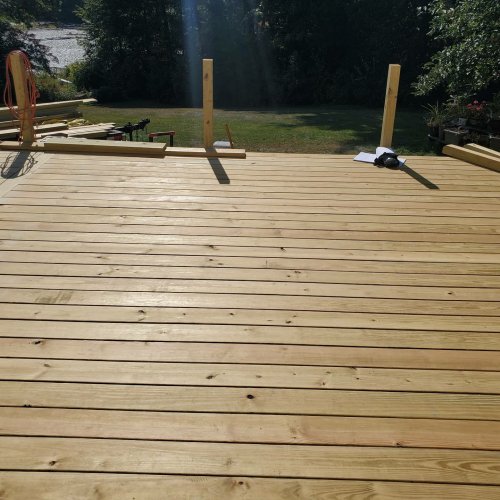
When an unexpected tragedy happens—especially the one that happened to my family—the natural instinct is to feel completely helpless. But in retrospect I see that I did have choices. And I made some crucial ones even in the midst of an ugly, all-consuming depression. I invited my sister, brother-in-law, and nephews to come visit almost every weekend. I asked my parents to go with me to pick up the new puppy I adopted. I accepted a former colleague’s—now a good friend’s—invitation to walk and talk and mourn. And I made a phone call to a contractor to rebuild the massive deck in my backyard.

It’s interesting to discover what different things for each of us become a symbol or an image of hope. A photograph, a painting, a special place, any number of trinkets or objects.

I know this might sound very strange to some, but my new deck has become that symbol of hope for me. Especially in the summer I will spend hours sitting on it, feeling the warmth of the sun on my skin, reading, feeding the birds, thinking. In recent years this happy place of mine has become worn to the point of being a mess and even unsafe. Within two weeks of Alan being killed I made that phone call to the contractor I mentioned above. At the time it felt impulsive, but in retrospect it was the beginning of creating a space that feels like my own, that I have control over, and that I’ve made a deliberate decision to change and improve. I keep joking that the puppy and the new deck are the two best decisions I’ve made this year, but I do think that this is actually true. A friend on Twitter commented that I’ve created a healing space with the new deck and some other areas of the house I’ve redecorated and rearranged. She couldn’t be more right.
There are still days when I think of how my husband was killed and our shattered family and the effect on our daughter and it feels like I’ve been punched in the chest all over again.

But this morning I was standing in the kitchen baking muffins, with our new puppy sitting at my feet, while my daughter was taking her morning class online, and a friend stopped by for coffee and to pick up some tools. I had a sense of happiness, and contentment, and even joy.

I have pangs of guilt—-which everyone tells me is natural—when I feel happy. Is it wrong for me to carry on with my own life? Is it fair that I get to carry on? But what is the alternative? Should I not do things that make me laugh or smile? Should I stop finding joy and pleasure in the company of the people with whom I’ve surrounded myself? Should I stop finding things, small things, to be grateful for every day?

But if I stopped, then I would give up that fight. And I don’t think that’s even a possibility for me.

As the season changes to autumn and the air is cooler I finally feel like I can breath a bit easier. The fog and sweltering oppression—literally and figuratively—of this summer is lifting. And the colors on the pond in my yard are starting to turn into lovely shades of red and gold. John Clare’s poem “Autumn” that I happened to read this morning captures my feelings very well:

Hill-tops like hot iron glitter bright in the sun, And the rivers we’re eying burn to gold as they run; Burning hot is the ground, liquid gold is the air; Whoever looks round sees Eternity there.…

When I look out over my yard I see my new deck in progress, I see the talented person crafting this beautiful space for me, I see the colors on the pond, I think about John Clare’s poem. I smile. I feel hope.

17 Comments

Filed under Uncategorized

It Is Unnatural For Us To Be Apart

I was chatting on Twitter with a friend who lost his mother this year after she fought a long, difficult battle with cancer. When I mentioned the overwhelming amount of paperwork I feel buried in after my husband’s death he remarked that when a loved one dies it’s very difficult because we must expend all this energy to erase the life of the one whom we are grieving. It seems so cruel.

And in some cases in order to cancel Alan’s existence it wasn’t enough to produce a death certificate but his birth certificate and our marriage license were also required which I found equally depressing and funny. Alan was a packrat who kept everything, so I waded through his drawers of papers to find this proof of his life with which I was going to erase that very life. As I was searching I found a box filled with every handwritten letter I had given or sent him.

I was, by far, the hopeless romantic between the two of us, oftentimes leaving him little notes—I actually packed his and our daughter’s lunch every day and would still leave both of them notes—from the very beginning of our relationship. I have always loved handwritten, personal letters; they are so much more tangible, intimate and sensual than the digital correspondence to which we have become accustomed in the 21st century.  There is a certain anticipation and excitement when one sends a letter and eagerly waits for a response; to see the other person’s handwriting, to touch the object they once touched, to tuck it away in a special place are all of the things we lose with electronic communication.

I don’t have many notes or letters from Alan, but apparently he kept every single one I wrote to him. It was too painful and too soon for me to read all of the letters and notes now. So I picked two of them to look at—the first one a birthday card in the shape of a motorcycle (I don’t remember how I managed to find that!) and the second a letter I sent during a year in which we were dating long distance. When I got my first teaching job in New England I moved here while Alan finished up graduate school in New York and we wrote letters, called and saw each other whenever we could. In a letter during this time apart, words that so haunt me now, I said to him: “In case you haven’t already guessed, I really miss you. I can’t wait until we can be together again…I thought what you said on the phone tonight was so touching—that it is unnatural for us to be apart.”

Yes, unnatural for us to be apart. Someday I will show these letters to our daughter so she will remember how much love we shared. But I also feel like I need to show her that the best way to honor that love is for us to move on and find happiness in other ways.

One of the later letters that author Paul Celan wrote to his lover Ingeborg Bachmann, when it was obvious that their love affair would never work out and they were doomed to be apart, keeps occurring to me. Celan writes to her, “Life is not going to accommodate us, Ingeborg; waiting for that would surely be the most unfitting way for us to be. Be—yes, we can and are allowed to do so.  To be—be there for another. Even if it is only a few words, alla breve, one letter once a month: the heart will know how to live.”

A daily and delicate balance of grieving and yet moving forward. A life lived to the fullest but now erased. The heart will know how to live…

13 Comments

Filed under Uncategorized

Hope Is A Thing With Feathers…

Before my husband was killed in a motorcycle crash the three most important things in my life were my family, my career/students, and my books/blog/literary Twitter community. But the life I once knew has been shattered. Not just me and my daughter, but my beloved sister, brother-in-law, and twin nephews and my parents are all grieving. And the close friends whom we consider family share our sorrow.

I’ve been trying to do what feels like regaining my balance—figuring out what fits into this new and very different life I have now as I move forward.

And so I keep thinking, “Well now what?”

The introduction I wrote for a review on J.L. Carr’s book A Month in the Country also keeps running through my mind:

Hope is a thing with feathers, according to Emily Dickinson.

And Max Porter.

Hope floats, according to the film title.

Pope writes in his “An Essay on Man” that “Hope springs eternal.”

Pink, in her collaboration with Khalid “Hurts 2B Human,” sings that “hope flows away.”

In Aeschylus’s play, Prometheus says he gave to humans the gift of blind hope.

J.L. Carr’s character in his novella, a victim of shell shock and abandoned by his wife, muses:

“This is what I need, I thought—a new start and, afterwards, maybe I won’t be a casualty anymore. Well, we live by hope.”

And hope is the one thing, quite ambiguously, left in Pandora’s box of evils. Is hope also considered an evil? And, if so, should we be glad that it was held in the box? Or is hope a good thing, left behind in the box and now separated from evil?

Alan and I spoke about the myth of Pandora’s Box usually about once a year, in the autumn, when we would give an adapted version of it to our respective first year Latin students.

I wonder what he would say to me about it now.

I identify most with Aeschylus’s offering of blind hope.

22 Comments

Filed under Uncategorized

Six Years of Blogging and New Bookshelves

WordPress has reminded me today that I have been blogging on this site for six years now. A small and modest achievement compared to bloggers like Steve at This Space, flowerville, and Stu from Winston’s Dad.

However, there also seems to be a trend of bloggers declaring that the blog and blogosphere are dead, abandoning their blogs and moving on to the latest and greatest forms of media like Instagram, podcasts, and YouTube. I was joking with a writer on Twitter who said the next thing we know there will be literary TikToks.

But especially now, in the area of lockdowns and pandemic, the quiet, kind and interesting corner of the Internet that consists of literary bloggers has been a source of friendship and solace for me. This also includes the wonderful connections I’ve made on Twitter via the bookish and artistic communities. Many of us are in lockdown with only a few family members or even alone—for me the only people I’ve seen are my husband and daughter. Going to work and having social interactions with colleagues and friends has also come to a hault. We are social beings and loss of daily human contact with a variety of people feels like something we took for granted. I am particularly grateful these days for my blog, my book friends and my Twitter friends. And so I carry on with these primitive and so-five-years-ago media platforms despite what the other cool kids have moved on to.

In other news, my Mother’s Day gifts were three new bookshelves for my bookroom. My poetry collection was getting out of control and as my daughter quipped in a Mother’s Day poem she composed for me, “I admire that you count books by the stack.”

It was exciting, albeit exhausting, to load and organize my new shelves and I’ve come up with some new categories with which I have that grouped my books together. I have collected so many books from Carcanet that they now have their own section:

Carcanet Press Collection

And I have been very interested in reading the diaries and notebooks of authors. I’ve been captivated, for instance, by Paul Valéry’s Notebooks which were published in English in 5 volumes. So now I have a section dedicated to such notebooks and diaries:

Diaries and Notebooks

I’ve also collected quite a few titles from Ugly Duckling Presse which publishes some of most aesthetically interesting books and chapbooks:

Ugly Duckling Presse Collection

I described in a post back in January that one if my reading goals for this year is to read a series of books about music so they have been given their own section:

Books about Music

The rest of the poetry books are categorized by country/region— English, American, Italian, Latin American, Russian, etc.

English, American, Italian, Latin American, etc.
More American poetry, Robert Kelly and Michael Hamburger
Russian and French Poets and Poetry Magazines

And finally, I have a shelf of books for my read now stack that used to be covering and stacked underneath the coffee table:

The Read Now Section

Now I’m wondering if maybe these “gifts” were a bit self-serving so that we can all see, and use, the coffee table again.

52 Comments

Filed under Uncategorized

Ars Adeo Latet Arte Sua: Infinity by Gabriel Josipovici

In Ovid’s Metamorphoses, Pygmalion is an artist who cannot find a wife that matches his ideal of what a perfect woman should be. So as an artist and sculptor he decides to make his own “woman.” Ovid says that the figure of a woman he sculpts is so flawless that one would think she is alive: ars adeo latet arte sua. (The art is especially hidden by its own skill.) In other words, the brilliance of Pygmalion’s art hides the fact that his sculpture is indeed art and not a real woman. Isn’t this the kind of seamless perfection towards which all artists or creators strive?

This idea concerning the creation of art came to mind as I was reading Josipovici’s novel about a composer named Pavone whose story is told to us by his longtime manservant, Massimo, after the artist has died. The narrative is told in a interview format, although we are never told why Massimo is being interviewed or by whom. The memories that Massimo has of his long-time employer are scattered and fragmented. The composer would have Massimo take him for long drives and would talk to him about his music, art, and his life. This fractured narrative is fitting for an artist whose work is considered flawless but who can’t quite describe what prompts such talent. We are given glimpses into Pavone’s life, from an early age as the only child of Sicilian aristocrats up until the time of his death. Sometimes the descriptions of his musical talent are bizarrely hyperbolic:

He said that he began to improvise at the piano at the age of three. I would rush upon any piano that happened to be around, he said to me, and I would beat it with my fists and kick it with my feet. But no one ever said to me: What are you doing? You will break the piano. No. Everyone was astonished, but they never told me to stop, he said. I am eternally grateful to them for that. All through my life, he said, I have rushed upon everything, music and poetry, women and food, with my fists and my feet flailing out, but no one ever told me to hang back. It is to that I owe my musicianship, he said, which is better than that of anyone in the world because it is an uninhibited musicianship.

But this still doesn’t fully explain his genius or his impetus for composing music. At other times Pavone, via Massimo, is more philosophical:

Music became too conscious at the beginning of the twentieth century, he said, it was necessary to return to its roots in the unconscious. Some people call this inspiration, a grand name for a simple thing. The root of the word inspiration is breath, he said, and all music is made of breath. If I have given anything to music, he said, it is that I have given music back its awareness of the importance of breathing, of breath.

A beautiful sentiment, but we are still non the wiser about the source of Pavone’s talent. Like many arts— that of Quignard’s character in Villa Amalia comes to mind—Pavone suffers a heartbreak which seems to be a catalyst for some of his best work. He has a tumultuous marriage with an English woman who leaves him and never contacts him again. In order to escape and make himself feel better, he takes a trip to Nepal which he believes is a turning point in his career. When his wife leaves he stays with Michaux in Paris and makes friends with the author’s cat and remarks, ” If only humans beings were as self-contained and undemanding as cats, he said, marriage would be a much more successful institution.” I don’t think Pavone truly understands cats or marriage. And the dissolution of this relationship and his travels don’t fully explain his artistic genius.

A childhood conducive to creating, heartbreak, travel—these are not unique things. Many artists have experienced these circumstances, but this doesn’t necessarily mean they will attain the level of talent that Pavone does. Pavone can go on and on, to infinity, trying to explain the source of his drive to create music. But, in the end, Ovid is right, the art is hidden by its own skill and there really are no words for it.

8 Comments

Filed under Uncategorized
