Category Archives: Literature in Translation

Review: The Dirty Dust by Máirtín Ó Cadhain

I received a review copy of this book from Yale University Press.  This book was published in Irish in 1949 and this is the first time it has been translated and published in an English edition.  The translator, Alan Titley has a well-written introduction at the beginning of the book that includes some interesting information about the history of Irish language and literature.

My Review:
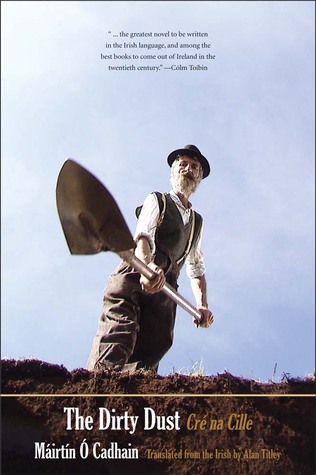
Dirty DustThis book takes place in the cemetery of a small town in western Ireland where corpses engage in conversations that continue the pettiness and gossip that dominated their lives when they were still aboveground.   Caitriona Paudeen, the most outspoken, and the most foul-mouthed in the group has a severe dislike for her sister, Nell and her daughter-in-law.  Caitriona’s vehement dislike of her relatives stays with her on the other side and it seems to intensify when she hears news of their lives as they continue on without her.

THE DIRTY DUST is one of the most unique premises for a book that I have encountered.  The dialogue in the book is not the typical streamlined speech that one encounters in a more conventional narrative; the conversations on which the reader is eavesdropping are bits and pieces of information, complaints, and stories that the corpses are remembering from their former lives.  Because we are oftentimes launched into the middle of a conversation, it is not always clear who the speaker is in the narrative and one has to look for certain clues or turns-of-phrase that are uttered before a speaker can be identified.  The only time new information is introduced to the graveyard is when a fresh corpse is buried.  Each new corpse brings another opportunity for juicy gossip to be spread around the graveyard.

Through the course of their cacophony of conversations, we learn that this group of neighbors and family members are petty, jealous, bigoted, narrow-minded and foul-mouthed.  The town Postmistress opens everyone’s mail, Peter the Publican who owns the tavern waters down everyone’s drinks, and Huckster Joan who is the town merchant poisons everyone with her terrible coffee.  They bring up old arguments about football games, money and wills; they are constantly spying on each other and wondering about the goings on of their neighbors.

Ó Cadhain also demonstrates his writing versatility though the use of philosophical and poetic speeches that occur at the beginning of each chapter or interlude.  At the beginning of Interlude 5 he writes, “Here in the grave the spool is for ever spinning; turning the brightness dark, making the beautiful ugly, and imbricating the alluring golden ringlets of hair with a shading of scum, a wisp of mildew, a hint of rot, a sliver of slime, and a grey haunting of mizzle.” As contrast to what happens in the graveyard he writes, “Aboveground everything is bedecked in the garments of everlasting youth.  Every shower of rain creates a multitude of mushrooms miraculously in the grass.”

THE DIRTY DUST is a timeless and brilliantly funny satire of life in a small town where old grudges are not forgotten, even when neighbors are buried six feet under the ground.  The only difference between life and death is that in death the people in this small town are stuck next to their neighbors from whom they can never escape.

About The Author:
Máirtín Ó Cadhain (1906 – 18 October 1970) was one of the most prominent Irish language writers of the twentieth century.

Máirtín Ó Cadhain was born in Cois Fharraige in the Connamara Gaeltacht in 1906. He is best known for his major novel, Cré na Cille (Dublin, Sáirséal agus Dill, 1949). It has been translated into English as The Dirty Dust, and into many other languages, including Danish and Norwegian.

His short story collections include Idir Shúgradh agus Dáiríre, 1939, and An Braon Broghach, 1948, from which Eoghan Ó Tuairisc translated stories published under the title Road to Bright City (Dublin, Poolbeg Press, 1981); An tSraith ar Lár, (1967); and An tSraith Dhá Thógáil (1970).

A national school teacher in his early life, he was interned for his activities in the IRA during World War II. He became a lecturer in Irish in Trinity College Dublin in 1956, and became Professor of Irish there in 1969.

He died in 1970.
Leave a comment

Filed under Classics, Humor, Literature in Translation

Review: I Called Him Necktie by Milena Michiko Flasar

I received an review copy of this book from New Vessel Press.  This book was originally written and published in German in 2012.  The English version has been translated by Shelia Dickie.

My Review:
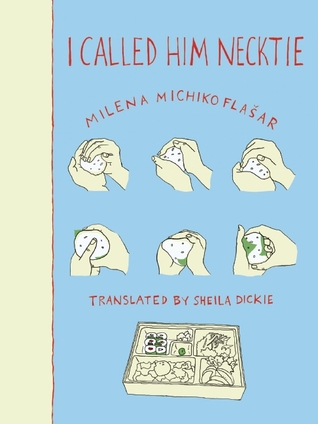
NecktieHikikomori is the Japanese term for youths who shut themselves into a room in their parent’s home and have very little contact with their family. According to Flasar, these young people may lock themselves away from society for up to fifteen years because they are overwhelmed by the expectations to conform and achieve in school and in their careers. Since being a hikikomori is an embarrassment to a family, no one knows the exact number of them that exist.

Flasar captures the loneliness, isolation and sadness that is felt by a hikikomori through the character of Taguchi Hiro in I CALLED HIM NECKTIE.  Taguchi has not come out of his bedroom in his parent’s home for two years and he even eats the meals that his mother leaves at his door in isolation.  One day Taguchi remembers the pleasantness of childhood when his mother would bring him to the park, so he ventures outdoors and sits in the same park.  He has waves of anxiety and nausea as he is trying to fight through his agoraphobia and the one thing that calms him down is a man who, dressed in a suit and tie, sits on a bench near him and meticulously eats the lunch from his bento box.

Taguchi and the man he calls “Necktie” show up at the park every weekday and eventually they strike up a conversation.  Taguchi’s family, neighbors, and teachers at school all put a tremendous amount of pressure on him to succeed and to fit in.  His conformity leads to what he believes are tragic consequences that involve two of his fellow classmates.  When the pressure to conform becomes too much, he closes himself off from his family, declares, “I can no longer” and he does not speak for two years.  The first person to whom Taguchi speaks after those two years is “Necktie” from the park and once Taguchi starts talking he does not stop.

“Necktie,” whose real name is Ohara Tetsu, comes to the park everyday because he has lost his job and cannot bring himself to admit this fact to his wife.  He adheres to his normal routine of waking up everyday at 6 a.m., dressing for work, taking the bento box that his wife has prepared, and riding the commuter train.  Ohara is the result of what happens to the youth in society who do conform: he is tired and worn out and thoroughly embarrassed when his career is taken away.

Ohara and Taguchi spend hours confiding in each other and through their conversation we learn of their struggles, heartaches, losses and phobias.  They both needed human interaction and human contact and fate brought them together at just the right time.  It is worth noting that they rarely have a dialogue in the book.  Either one of them is talking at length or the other.  They each longed for someone to truly listen without judgment and that is the gift that they give to one another.

The writing of the book is terse and curt with no quotations marks.  This is fitting for Taguchi and Ohara as their stories spill out from their mouths, sometimes in fragments and sometimes in philosophical reflections;  it seems as though they are desperate to share their lives with each other and make a connection as urgently as possible.

I CALLED HIM NECKTIE is an uplifting story about two people who feel isolated and abandoned by their society but find comfort in the attentive ear of one another.  I highly recommend this short, yet inspiring tale.


About The Author:
FlasarMilena Michiko Flašar (St. Pölten, 1980) studied comparative literature, Germanic and Roman languages at the University of Vienna, and taught German to non-native speakers. After several successful publications in a variety of literary magazines, she made her debut in 2008 with the collection Ich bin (I am). This volume includes three short stories about love and parting. The short story Okaasan – Meine unbekannte Mutter (Okaasan – My unfamiliar Mother) appeared in 2010, telling the story of her dying demented mother. She has received several prizes and scholarships for her work. Meanwhile she has started writing full-time. In feburary 2012 her new book Ich nannte ihn Krawatte was published.

Visit New Vessel Press for their fantastic selection of titles.  You can also download a translation from their site of the Chekhov short story “The House Call.”


5 Comments

Filed under Literary Fiction, Literature in Translation

Review: When The Doves Disappeared by Sofi Oksanen

I received an advanced review copy of this book from the publisher.  This book was originally written and published in Finnish and has been translated for this publication into English.

My Review:
Doves DisappearedThe setting of this story involves the sad history of Estonia, a country that is caught between two fascist superpowers and never allowed to be free.  The narrative moves back and forth between the period of World War II when Estonia is occupied by German forces, and the 1960’s when Estonia is under Soviet Control.

There is a patriotic group of Estonians who are trying to cast off the oppressive yoke of the Bolsheviks that has a grip on the county in the early 1940’s.   This group of revolutionaries are represented by the character of Roland.  Roland is a farm boy who has led a simple life, but he trains in Finland with a group of rebel Estonians who want to oust the Red Army and declare Estonian independence.  When the Germans cast the Red Army out of the country, Roland recognizes that one oppressive tyrant has been tragically replaced by another.  He continues his underground resistance and his goal is to cast off the Germans who are just as cruel and harsh as the Red Army.  Roland is a figure who possesses loyalty, honor and patriotism; he is true to his cause, the freedom of Estonia, no matter what happens in the story.

Edgar, Roland’s cousin, serves as a sharp contrast to the loyalty of his closest family member.  Edgar’s two driving goals in life are self-preservation and self-advancement.  When the Germans take over, he assumes a new name and attempts to make a career among the German government in Estonia by managing some of their labor camps.  When the Germans are run out of Estonia, Edgar takes on yet another new name and tries to ingratiate himself with the Soviet government by writing a book about all of the German atrocities that were committed while Hitler’s armies occupied Estonia.  Edgar does not particularly care who is in charge of the government, as long as he is seen as someone who is worthy of praise and attention.  His greatest desire in life is to be given special privileges and recognition as a result of his work for the government.

The most tragic character in the book is Juudit, Edgar’s wife.  Juddit is truly in love with Edgar when they first marry and she has such high hopes about spending a wonderful life together in wedded bliss.  However, Juddit is sorely disappointed when Edgar refuses to have any sexual relations with his wife.  It becomes apparent in the book that Edgar is homosexual and has no intentions of carrying on a physical relationship with a woman.  When Juddit meets a German officer stationed in Estonia, she has a mad, passionate love affair with him that lasts for the duration of the German occupation.  Juddit finally feels loved, wanted and fulfilled when a German officer gives her all of the attention and affection that she so desperately desired from Edgar.  Unfortunately for Juddit, when the Germans are driven out of Estonia, she is forced to go back and live with Edgar, at which point she carries on a sad and wretched life fueled by lots of alcohol and pills.

Sometimes the dual narrative that jumps between the two time periods becomes very confusing and convoluted.  It is hard to keep the names straight of which person is on which side, who is working for the Germans and who is still loyal to the Russians.  There are also certain storylines that I would like to have seen further developed.  For example, the details of Edgar and Juudit’s reunion after the Germans withdrawal from Estonia is never described.  How could these two people who despise each other end up living under the same roof again?  Also, Roland’s fiancée, Rosalie, suddenly dies in the beginning of the book and the suspicious circumstances of her death are not mentioned again until the very end.  Rosalie’s story could have been just as interesting as Juudit’s and I would like to have seen her character elaborated upon.

Overall, this is an intriguing historical fiction novel about World War II that revolves around a scarely spoken of country that was the victim of two oppressive regimes.  If you are a connoisseur of World War II historical fiction, then WHEN THE DOVES DISAPPEARED should definitely be on your “to read” list.

About The Author:
Sofi OksanenSofi Oksanen was born in Finland to a Finnish father and an Estonian mother. In 2010 she won the Nordic Council’s Literature Prize for her third novel (originally a play), Puhdistus (Purge).

3 Comments

Filed under Historical Fiction, Literature in Translation

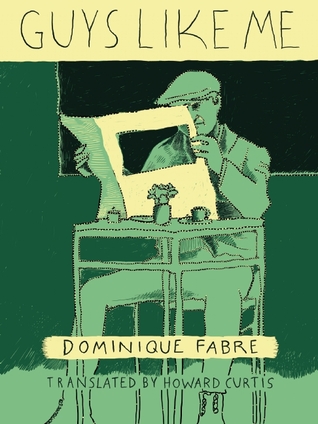
Review: Guys Like Me by Dominique Fabre

I received an advanced review copy of this book from the publisher through Edelweiss.

My Review:
Guys Like MeWhat surprised me most about this brief novel is how emotionally invested I became in the unnamed narrator.  Fabre creates a man who describes for us his everyday existence as a fifty-four year old man, living in Paris, divorced for 15 years, with a grown son.  He works a lot to pass the time and spends most nights alone in his small apartment.  He has two close friends he sees on a regular basis and has had a few casual relationships with women he has met on dating websites.  He continually and sadly says to himself throughout the first part of the narrative, “There are no second acts.”

He likes to reminisce about his past life and speaks about the anger he had for his ex-wife after she divorces him; their separation is so nasty that they haven’t stepped foot in the same room or spoken for 5 years.  But now that so much time has passed, he begins to wonder why he was ever so angry.  The best thing in his life that has come out of his marriage is his son Benjamin with whom he has a close, supportive and touching relationship.

The narrator’s two close friends serve as an interesting contrast to his own life.  His friend Jean, with whom he has just reconnected after many years, has been out of work and on welfare for years and he suffers from long bouts of depression.  Although the narrator is oftentimes lonely, his life is never as sad or miserable as Jean’s.  Marc Andre is the narrator’s other friend who is also divorced, but is happily remarried and has a large blended family.  The narrator’s relationship with Marco proves that as we get older, it is not the number of friends that becomes so important to us, but the depth of the relationships with the few people we keep close.

About halfway through the book, the narrator meets a woman online named Marie and it is hard to tell if he really cares about her or if she just fills up some of his lonely hours.  But as the story goes on, he subtly stops saying “There is no second act.”  He seems to really turn a corner in his life and be able to declare that good things still can happen to “guys like me.”

GUYS LIKE ME is a fast and emotional must-read; it will keep you wondering if F. Scott Fitzgerald was wrong and that second acts are possible for all of us.

About The Author:
Dominique-Fabre-Dominique Fabre, born in 1960, writes about people living on society’s margins. He is a lifelong resident of Paris. His previous novel, The Waitress Was New, has also been translated into English.

I love to support small presses that provide us with wonderful books like Guys Like Me.  Please support New Vessel Press and visit their website for more titles: newvesselpress.com.

1 Comment

Filed under France, Literary Fiction, Literature in Translation

Review: The Room by Jonas Karlsson

I received an advanced review copy of tis book from the publisher through NetGalley.

My Review:
The RoomBjorn works in a non-descript, government office in Sweden simply known as “The Authority.”  He is a self-important, regimented, quiet man who one day discovers a room in his office.  He likes to visit “the room” during his breaks and it seems to give him a sense of peace and calm and it heightens his sense of self-importance.

Due to his lack of social skills, Bjorn makes his co-workers very uncomfortable.  But when he insists that there is “the room” that no one else can see, they become even more agitated with him.  THE ROOM is a comic illustration of the hierarchies, petty differences and bizarre social interactions that exist in the microcosm of an office.

The book is very short, it is really more of a novella at 125 pages.  I do not want to say too much for fear of giving the plot away.  But in the end, the symbolism of “The Room” and Bjorn’s occupation of its space turns melancholy; when Bjorn sees things that others cannot, names like “freak” and “daft” and “crazy” are thrown at him.

THE ROOM is a great choice for a book club to discuss because there are many layers of symbolism to unpack and dissect.  If you read THE ROOM, please come back and share your thoughts in the comments.  I am especially interested to see what other readers have to say about the ending of this thought-provoking novella.

About The Author:
Sven Bert Jonas Karlsson is a Swedish actor and author. He won a Guldbagge Award for Best Actor in 2004 for the movie Details. He published his first book, a collection of short stories, in 2007.


4 Comments

Filed under Literary Fiction, Literature in Translation