
 As I read the poems and two dramas included in this translation of Poetic Fragments, I couldn’t help but think of a letter that Karoline von Günderrode wrote to her lover Friedrich Creuzer, a German philologist and archaeologist:
I can’t understand the change in your feelings. How often have you told me that my love brightens, enlivens your whole existence, and now you find our relationship damaging. How much would you have given once to win this “damage” for yourself! But that’s the way you [men] are, what you’ve conquered always seems to be lacking….You seem to me like a boatsman to whom I’ve entrusted my whole life, but now the storms are raging, the waves rise up. The winds bring me scattered sounds; I listen and hear how the boatsman takes counsel with his friends whether he shouldn’t throw me overboard or put me ashore on the barren coast?
Although they had a loving, passionate affair and Creuzer was planning to leave his wife for Karoline, the hardships that their relationship caused launched both of them into a depression. Günderrode committed suicide with a dagger in 1806 after Creuzer broke off their affair via a letter. The themes of love and death pervade Günderrode’s writing and demonstrate her deep interest in these philosophical concepts. The last stanza of her poem “The Kiss of a Dream” explores that fine line between erotic love and death:
The day is meager in love-sweet delights,
Its light’s vain boats hurt me
And its sun’s blazes consumes me
So hide, eyes, from the luster of the earthly sun!
Wrap yourself in night, it slakes your longing
And heals the pain, like Lethe’s cool floods.
This poem is particularly reminiscent of her letter to Creuzer, although I find the poem more hopeful; Lethe’s floods are soothing and, because of its powers to erase memory, have the ability to ease suffering.
Another intriguing commonality that I found in the additional poems as well as the two plays in this collection are her descriptions of love involving trios. In the poem entitled “Piedro,” a sailor launches his ship headlong into the waves to retrieve his love that was captured by another man. In the battle that ensues, Piedro kills a youth with whom he instantly falls in love. Even though Piedro gets his woman back, he can’t stop thinking about the youth he longs for and decides that the only way to be with him is to take his own life:
Darkness rests upon the waters
Deep silence all around
Piedro’s ship reaches the coast,
But he sleeps deep in the ocean.
The plays in this collection are enchanting in both language and topic. In Hildgund, the Lord of the Burgundian’s daughter is captured by Attila the Hun and then rescued by her beloved fiancé, Walther of Aquitania. When Attila threatens to conquer all of Europe unless Hildgund agrees to marry him, she sacrifices herself for the safety of her country. The play ends abruptly when Hildgund is about to join a wedding party hosted by Attila at which event she has in mind to murder him. Hildgund is brave, passionate and willing to put herself in danger for Walther. Günderrode’s speech for Hildgund is courageous and showcases a woman who is not willing to be passive while a man decides her fate:
Oh Walther! Yet you will indeed one day be avenged
And he regret his robbery’s brief joy.
Why do I hesitate, is it, then, too monstrous,
For shy, pale lips to name it?
Murder! Ha, the name alone appalls,
the deed is just, and bold and great,
The peoples’ destiny rests in my breast;
I will free them, free me.
Banished are fear and childish hesitation,
Only a bold warrior wins a great goal.
The final play in this collection, the topic of which I found the most curious, is Muhammad, The Prophet of Mecca. Günderrode was very interested in the East and chose the struggles of this prophet to write about the afterlife. The choral odes Günderrode composes are beautiful and lyrical and worth reading the play just for those interludes. Muhammad, who is banished from Mecca because of his teachings about one god, tells one of his enemies about the fate of the soul in the afterlife. Once again, I find the tone of Günderrode’s writing positive and uplifting:
Mohammand: The soul of man does not die with the death of the body; it abandons it when its life has ended, and if it is the soul of a pious person then it climbs aloft in the space of the stars and creates itself a body out o fair; this new body has all senses like the previous, only in a yet higher degree; it never gets tired, knows no pain and is full of eternal health, life and youth.
Most of the literature that has been written about Günderrode has focused on her love affair with Creuzer, her personal letters and her tragic end. She was, however, a talented poet, philosopher and dramatist whose work is virtually unknown to the English speaking world. This dual language edition of Poetic Fragments, translated with introductory essays by Anna Ezekiel, focuses on Günderrode’s contribution to philosophy and literature of the German Romantic movement. I highly recommend this book for both the translations and Ezekiel’s insightful essays and comprehensive bibliography. I am disappointed that most of Günderrode’s writing has not been translated into English as this publication has made me want to read all of her literature.
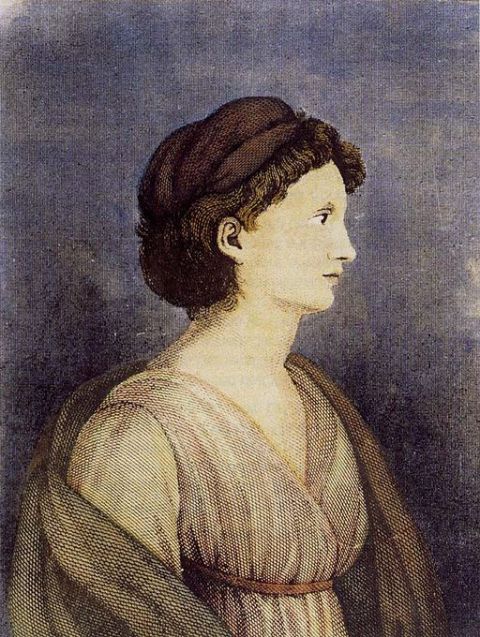
Karoline von Günderrode, c. 1800, by an anonymous painter; Historical Museum, Frankfurt am Main
 Kafka’s final novel describes a land surveyor, simply known as “K.” arriving in an unnamed village, over which looms a castle and its mysterious bureaucracy. Through K.’s attempt to find out why he has been sent and what he is supposed to do in the village, Kafka captures the feelings of alienation, anxiety, loneliness, pain and existential angst that are universal to the human condition. Conversations with the village mayor, the schoolteacher, the landlady of the inn and a woman to whom he becomes engaged never help K. feel settled or at home in this strange place which he refuses to leave.
 What more can really be said about Kafka’s writing? I feel almost embarrassed to share my thoughts about this new volume of translations by Michael Hofmann; there will be nothing new or earthshattering here, but I am hoping that fellow Kafka lovers will at least be happy to stumble across another devotee. Please go easy on me as I offer my humble observations on this collection!
 Aeschylus’s tragedy The Suppliant Women is a unique piece of Ancient Greek theater because the poet uses the chorus, normally reserved for a secondary role, as the protagonist of his play. The Danaides, the fifty daughters of Danaus, are refugees from Egypt where they were going to be forced into marriage with their cousins. Having chosen flight from Egypt instead of mandatory betrothal, The Danaides arrive in Argos seeking asylum. As the chorus/protagonist of this tragedy, these women tell us, with one, strong, loud, simultaneous voice, about the hardships they’ve suffered and they beg, as suppliants at the altar of Zeus, for protection.

 In this new translation of Kafka’s prose published by Archipelago Books last year, Peter Wortsman has chosen a wonderful selection of shorter writings that showcases the range of the author’s brilliance. Old favorites such as “The Metamorphosis,” translated in this collection by Wortsman as “Transformed” appear in the volume with fresh, updated language for a 21st century audience. For those who are new to Kafka’s writing, the inclusion of additional classic short pieces such as “The Penal Colony” and “A Report to an Academy” make this a perfect volume with which to be introduced to his writing.
 Peter Wortsman was a Fulbright Fellow in 1973, a Thomas J. Watson Foundation Fellow in 1974, and a Holtzbrinck Fellow at the American Academy in Berlin in 2010. His writing has been honored with the 1985 Beard’s Fund Short Story Award, the 2008 Gertje Potash-Suhr Prosapreis of the Society for Contemporary American Literature in German, the 2012 Gold Grand Prize for Best Travel Story of the Year in the Solas Awards Competition, and a 2014 Independent Publishers Book Award (IPPY). His travel reflections were selected five years in a row, 2008-2012, and again in 2016, for inclusion in The Best Travel Writing. He is the author of two books of short fiction, A Modern Way to Die (1991) and Footprints in Wet Cement(forthcoming 2017), the plays The Tattooed Man Tells All (2000) and Burning Words (2006), and the travel memoir Ghost Dance in Berlin: A Rhapsody in Gray (2013), and a novel Cold Earth Wanderers (2014). Wortsman’s numerous translations from the German include Telegrams of the Soul: Selected Prose of Peter Altenberg, Travel Pictures by Heinrich Heine, Posthumous Papers of a Living Author by Robert Musil, Peter Schelmiel, The Man Who Sold His Shadow by Adelbert von Chamisso, Selected Prose of Heinrich von Kleist, and Konundrum: Selected Prose of Franz Kafka, many of which are published by Archipelago Books. He edited and translated an anthology, Tales of the German Imagination: From the Brothers Grimm to Ingeborg Bachmann, from Penguin Classics. He works as a medical and travel journalist.


 The Book Binder's Daughter