Author Archives: Melissa Beck

Melissa Beck's avatar

About Melissa Beck

My reading choices are rather eclectic. I enjoy reading a wide range of books especially classics, literature in translation, history, philosophy, travel writing and poetry. I especially like to support small, literary presses.

Review: Going Bush by Kirsty Gunn

My Review:
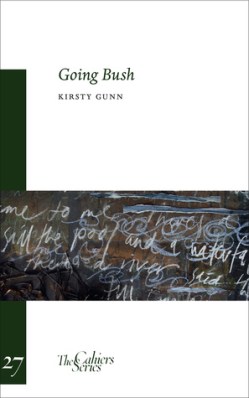
going-bushKirsty Gunn’s contribution to the Cahier Series is a meditation on the bush of New Zealand and her childhood memories of this dark and mysterious place.  The book begins as a memoir with Gunn describing the park in her neighborhood with swings, slides, games and a swimming pool.  But lingering at the edges of this childhood playground was the bush, “a dark presence waiting at the end of all the brightness and play.”

Gunn describes and defines the bush in various ways; it looms over the playground, thick and dark, so to children it seems like a scary, unknown place.  It never has a specific season but instead parts of it bloom while other parts die all year round.  “It was dark and wet-smelling,” she says, “half the things in it were rotting and the other half in bud.”  The bush was also a place that the men liked to disappear for several days while hunting and living wildly.  When they came back they would smell of wet and earth but feeling relaxed and free.  There was an expression that the men used, “Going Bush” which meant that a person would go into this tangled and difficult terrain and allow himself to be changed by the experience.  “Only men went in there, into the Tarawheras, or the Ureweras or the Kaimanawa Ranges.  They came home, sun-blackened and with beards or stubble on their faces, laughing and smelling of earth and drink and something else—seeds or mould or blood.”

The author herself, as a young girl going through the bewilderment and confusion of puberty, describes the bush as something that provides a solace for her.  The writing switches to narrative form that depicts the summer in the author’s adolescence during which she meets her father’s family for a picnic.  She has just started menstruating that very day and her mother has made her feel embarrassed about her changing body.  Her cousins are cruel to the girl who is already self-conscious of her growing body which she covers up with baggy clothes and sweaters.  As the picnic progresses, she can’t take her cousins’ insulting remarks any longer so she slips into the bush.  The bush becomes for her a hideaway, a refuge where she can shed her layers of clothing and swim unencumbered in the cool river.  Gunn personifies the bush as it calls to the girl and soothes her: “‘Use me,’ the riverbank had told her then. It had said the same again as she had stood there like a mighty tree, dark and silent, while the terrible cousins ran straight on past her—and she had let them go.”

Gunn’s exploration of the bush and it’s various meanings brings this experience of New Zealand alive for us in this cahier; many view this dark, tangled place as inhospitable but its wilderness protects her during a vulnerable moment in her early years.  The blending of different genres—memoir, narrative, diary and even poetry— are each a fitting way to present different and multilayered perspectives of the bush.

Kirsty Gunn’s sister, Merran Gunn, has done the mixed media art work to go along with this cahier.  I enjoy looking at the images in the cahier series as much as I enjoy the writing.  My plan is to read every book in the series.  I have started with the latest publications, number 29 and 27 and will work my way up to the earliest cahiers.

About the Author:

kirsty-gunnKirsty Gunn was born in 1960 in New Zealand and educated at Queen Margaret College and Victoria University, Wellington, and at Oxford, where she completed an M.Phil. After moving to London she worked as a freelance journalist.

Her fiction includes the acclaimed Rain (1994), the story of an adolescent girl and the break-up of her family, for which she won a London Arts Board Literature Award; The Keepsake (1997), the fragmented narrative of a young woman recalling painful memories; and Featherstone (2002), a story concerned with love in all its variety. Her short stories have been included in many anthologies including The Junky’s Christmas and Other Yuletide Stories (1994) and The Faber Book of Contemporary Stories about Childhood (1997).

She is also author of This Place You Return To Is Home (1999), a collection of short stories, and in 2001 she was awarded a Scottish Arts Council Writer’s Bursary. Her latest books are The Boy and the Sea (2006), winner of the 2007 Sundial Scottish Arts Council Book of the Year Award; and 44 Things (2007), a book of personal reflections over the course of one year.

Kirsty Gunn lives in Edinburgh, Scotland

9 Comments

Filed under Cahier Series

Review: O Fallen Angel by Kate Zambreno

fallen-angelAnna K. Yoder, who interviewed Kate Zambreno in 2010 about her first novel, describes O Fallen Angel: “Zambreno’s first novel reads like the bastard offspring of an orgy between John Waters’s Polyester, Elfriede Jelinek’s Lust, and Oliver Stone’s Natural Born Killers.”  Similar to these other cutting edge artists, Zambreno experiments with structure, language, and setting to present a novel that is disturbing and bizarre.

Zambreno’s triptych story is written from the point-of-view of three very different characters: Mommy, Malachi and Maggie.  The background of the book is the American Midwest, somewhere in suburbia where everyone has a white picket fence, two or three children and a respectable job.  The catholic, white, middle class, suburban family portrayed in the book appears happy and idyllic on the surface.  But just like the Francis Bacon triptych, Three Studies for Figures at the Base of a Crucifixion, from which Zambreno takes her inspiration for the novel, the family is in reality dysfunctional, monstrous and grotesque.

When Mommy speaks, the text is child-like, simple and monotonous.  Mommy adheres to strict, Catholic rules of morality and expects the same from her children, Mikey Junior and Maggie.  Mommy’s daily life is ordered—cooking, cleaning, taking care of children and grandchildren, walking the dog.  Mikey is her favorite child because he did what was expected of him, he married a nice woman, not too pretty, who has already given him two children.  It is her daughter, Maggie, that is considered  Mommy’s Fallen Angel because she has not gotten married and had babies, but instead has run off to the big, bad city.  Maggie is the “bad egg,” the one that Mommy tries to pretend doesn’t exist anymore.  Unlike her brother, Maggie has not conformed to Mommy’s expectations of what a good, Catholic girl’s life should look like.  The guilt, emotional blackmail and suppression of feelings don’t work on Maggie like they do on her brother.

Maggie’s point-of-view is focused on her body—raw, corporeal, sexual.  She has sex with lots of men and confuses physical contact with love.  She goes to college as far away as she can to get out from under the expectations of her parents who don’t approve of her chosen major of psychology.  And when she drops out of college and takes a job as a waitress they try not to think about their “bad apple” and insist that any failure of Maggie’s is no fault of theirs.  Every time we encounter Maggie’s voice she seems to be losing more control of her life.  She sleeps with men to get things she needs, consumes a concoction of different substances and loses her job.  Maggie’s body, bloated and laden with genital warts and drugs is an outward reflection of the mess that her mind has become.

Malachi is the most bizarre voice of the three presented in the book.  Like his Biblical namesake, his appears to be a prophet of doom, a Cassandra like figure, as he wanders about the streets of the suburbs and observes middle-class people going about their daily routines. Zambreno also uses Malachi’s speech as a type of chorus to make political commentaries throughout her text. He reads one of his messages:

A great fireball will erupt from the sky

one cannot reason anymore with the President

one life for the life of
thousands

lies lies lies
airplanes

warlords
profits
false idols
prophet

Finally, an additional note on structure which reflects Zambreno’s nod to the Oresteia.  The House of Atreus from which Agamemnon is a descendant  is one of the most morally reprehensible and fucked up families in all of Greek myth; they violate almost every social taboo imaginable.  Zambreno could not have chosen a more appropriate model on which to base her dysfunctional, Midwestern family.  In the style of Ancient Greek tragedy, she inserts choruses within her text that foreshadow the themes and the disturbing outcome towards which her narrative is moving.  The book opens with this chorus:

There is a corpse in the center of this story
There is a corpse and it is ignored
No one looks at the corpse
Everyone no-looks at the corpse

There is a gaper’s block, it is blocking up traffic
It is in broad daylight, this dead body

There are other corpses that are ignored:
corpses far away in another country
enemy corpses

living corpses
walking corpses
working corpses

But when a mere mortal dies we do not see it
We look we gape but we do not see it
We do not mourn the ordinary

It is nothing like the death of a celebrity
To lose them, these constant images
is to remind ourselves that we will die
We will die, too, yet no one will care

Our deaths will not be televised
Then who will watch it?

As someone who grew up in a very conservative family and who was sent to an all girls Catholic high school, I found this book extremely difficult to read at times.  I always felt as if I were being crushed under the weight of the strict rules, guilt, and suppression of feelings that were engendered at school and at home.  I didn’t find my true identity until I was able to break free of that tradition and that religion being forced upon me.  My life, of course, did not take the same destructive path as Maggie’s does  in the book, but I can certainly understand why her life under her parent’s influence brought on such extreme behavior.

12 Comments

Filed under Literary Fiction

Conversations with Faye: My Thoughts on Outline by Rachel Cusk

My Review:

outlineWhen my daughter was in preschool and I started taking her to various birthday parties and playdates to which she would be invited by her friends I always felt awkward and out-of-place. I was oftentimes the only mother at these gatherings who had a career and an only child.  When I would confirm that my daughter is an only child I would get a look, a comment:  “Oh you only have one child.”  I felt as if having a single child made me a mother, but not enough of a mother to be considered a part of their club.  And after my daughter was born I remember various family members asking not if we were having more children but when.   Of the various people portrayed in Cusk’s Outline, I identified most with Angeliki, a writer of contemporary women’s fiction, who describes her marriage and her reasons for having one child with her husband.  Because of my experiences with how people react to my decision to have an only child ,Angeliki’s story and her words particularly resonated with me.  Her remark at the thought of having more than one child is startlingly honest, “I would have been completely submerged.”
In Rachel Cusk’s first book of a trilogy that is loosely autobiographical, a recently divorced author named Faye is traveling to London from Greece where she will teach a short writing workshop.  While on her travels she encounters various people like Angeliki who share the stories of their lives, their loves, their identities and their perceptions of the world.  It is through their stories that the author starts to realize how her own identity and perception of the world have had a dramatic shift since the dissolution of her marriage.  On the plane ride to Athens, she meets a man who was raised in Greece but was educated in English boarding schools.  She simply refers to him as “her neighbor” throughout the narrative as he proceeds to give her the details about the passion, progress and dissolution of two of his marriages.

While in Athens, Faye meets others—a writer, a publisher, a fellow teacher, her students—with whom she has lengthy conversations.  She goes on a boat ride and a swim with her neighbor from the plane where she observes another family having an outing.  As she notices the ways in which father, mother and children interact with one another in a mundane setting Faye observes:  “I was beginning to see in other people’s lives a commentary on my own.”  This simple yet profound statement signifies that the discussions with her friends and her acquaintances are continually reshaping and reforming her own identity and her own views of the world as a single woman, a single mother, and as a person that is no longer half of a couple.

Cusk’s writing is philosophical and meditative and she uses her talents to make simple settings appear unique and intriguing.  An airplane ride, a swim in the ocean, dinner at a seedy Greek restaurant are all seen from a new point-of-view and become vivid backdrops for Faye’s conversations during which people share the most intimate details about their lives.  Her description of the atmosphere on the plane also appears to be a commentary on the various lenses through which we view others:

The plane seemed stilled, almost motionless; there was so little interface between inside and outside, so little friction, that it was hard to believe we were moving forward.  The electric light, with the absolute darkness outside, made people look very fleshy and real, their detail so unmeditated, so impersonal, so infinite.

One subject, in particular, that runs throughout all of the conversations is marriage and family life.  Cusk’s book could have easily turned into a typical narrative oftentimes found in contemporary women’s fiction that presents one lamentation after another condemning marriage and lauding the single woman as a heroine of strength and fortitude despite the horrible personality flaws of an ex.  Cusk’s approach to writing about marriage is more intelligent and philosophical; she understands that life is complex and she reaches beyond the usual, fictional narrative to underscore these complexities.  Faye offers little detail about her own life to her various acquaintances, but when she does voice her opinions during theses conversations they are thought-provoking and profound.  She says to her neighbor on the plane,   “Among other things, a marriage is a system of belief, a story, and though it manifests itself in things that are real enough, the impulse that drives it is ultimately mysterious.”

Cusk’s novel  is a meditation on life, love, relationships and our multilayered and ever-evolving perceptions of these things.  It will be very interesting to see how she continues her conversations about these topics in the next book of the trilogy entitled Transit.

For more interesting reviews and comments on Cusk’s books visit: Times Flow Stemmed and flowerville.

About the Author:

cuskRachel Cusk was born in Canada, and spent some of her childhood in Los Angeles, before her family returned to England, in 1974, when Cusk was 8 years old. She read English at New College, Oxford.

Cusk is the Whitbread Award–winning author of two memoirs, including The Last Supper, and seven novels, including Arlington Park, Saving Agnes, The Temporary, The Country Life, and The Lucky Ones.

She has won and been shortlisted for numerous prizes: her most recent novel, Outline (2014), was shortlisted for the Folio Prize, the Goldsmith’s Prize and the Bailey’s prize, and longlisted for Canada’s Giller Prize. In 2003, Rachel Cusk was nominated by Granta magazine as one of 20 ‘Best of Young British Novelists’

She lives in Brighton, England.

15 Comments

Filed under British Literature

Lucretius, Epicureanism, and a sinking ship: My thoughts on the Inauguration

Battle of Actium. Castro, 1672.

Battle of Actium. Castro, 1672.

The beginning of Book II of Lucretius’s De Rerum Natura has always been one of my favorite parts of this Roman poet’s epic.  As Inauguration Day approaches in my country, I keep mulling over these lines for various reasons which I will explain.  First, I offer my translation of De Rerum Natura 2.1-19:

Suave, mari magno turbantibus aequora ventis
e terra magnum alterius spectare laborem;
non quia vexari quemquamst iucunda voluptas,
sed quibus ipse malis careas quia cernere suavest.
suave etiam belli certamina magna tueri
per campos instructa tua sine parte pericli;
sed nihil dulcius est, bene quam munita tenere
edita doctrina sapientum templa serena,
despicere unde queas alios passimque videre
errare atque viam palantis quaerere vitae,
certare ingenio, contendere nobilitate,
noctes atque dies niti praestante labore
ad summas emergere opes rerumque potiri.
o miseras hominum mentes, o pectora caeca!
qualibus in tenebris vitae quantisque periclis
degitur hoc aevi quodcumquest! nonne videre
nihil aliud sibi naturam latrare, nisi ut qui
corpore seiunctus dolor absit, mensque fruatur
iucundo sensu cura semota metuque?

It is pleasant, when on the vast sea the winds are stirring up
the water, to look at the great misfortune of another person
from the land; not because it is pleasant to rejoice in
another man’s troubles, but because it is a relief to
comprehend what types of evils from which you yourself
have been spared. It is pleasant indeed to look upon great
battles in war being carried out on the battlefield,
the dangers of which you have no part in. There is
nothing sweeter than to possess the fortified, lofty doctrines of
the wise, as serene temples, from which place you might look
down upon others and see that they wander everywhere
seeking a path for their aimless lives, as they struggle with
their intelligence and fight for nobility, as night and day
they wrestle with great toil to climb to the highest
mountain of riches and to acquire things.
O miserable minds of men, o blind souls!
In what shadows of life, in what perils is this age of
yours have you passed! You see, don’t you, that nature barks
for nothing other than this, that pain be severed from the body
and that the mind, freed from worry and fear, enjoy
a pleasant feeling.

As I have spoken to various friends from around the world, especially in the blogging community, I can’t help but feel that other countries are standing on the shores and watching in horror the shipwreck that is occurring in American politics with the inauguration of our 45th President. I have a sense that Canadians in particular, with their universal healthcare, and progressive Prime Minister, are grateful, in the sense Lucretius describes, that they are not part of these turbulent waters in which we Americans have found ourselves drowning.

As the Inauguration approaches, I have tried very hard not to read about any of the preparations for it and I have also vowed not to watch the news coverage on the day of the event. I don’t want to experience this shipwreck of an historical event, but then I realized that perhaps my inability to watch the shipwreck signifies that I have created an illusion for myself. It’s not that I don’t want to watch it, but instead it’s impossible for me to see it because I am on that very ship, being drowned in those waters which the wind has stirred up. Sometimes it’s very difficult not to have such a feeling of despair.

In order to mitigate our despair what are those “lofty doctrines of the wise” Lucretius suggests to which we can cling? How do we counteract a war being played out in horror in front of our eyes—a war against healthcare, basic human rights, freedoms and liberties? We cannot exist in some Epicurean garden or paradise and simply watch these things happen without being affected and without protest or action.

I can’t help but think of our incoming president as I translate Lucretius’ description of men who crave riches and devote their lives to the acquisition of things. It is evident from any thirty-second sound bite we hear that our new leader struggles with intelligence (ingenio) and has quite a lofty view of his own nobility (nobilitate). I site as an example of this exaggerated sense of nobilitas the opulent signs displaying his name on every building he owns or partially owns.

Finally, I particularly admire Lucretius’ word choice in the last few lines when talking about pain (dolor)—our nature barks or howls out (latrare) for us to get rid of any type of pain that invades our bodies and to embrace those things that bring us pleasure. How can we apply Lucretius’ advice to our current political situation? Lucretius’ suggestion of avoidance, as I noted above, seems impossible in this instance. Avoidance, in fact, is downright irresponsible. We are left with the other piece of his philosophy—to embrace those things that give us pleasure. For me this would take the form of reading, writing, connecting with friends, holding my family especially close and setting an example of kindness, tolerance and understanding for my daughter and my students. Will this be enough to mitigate the pain? Who knows. Perhaps it might be better to look to the Stoics or the Cynics for more philosophical advice in this instance.

17 Comments

Filed under Classics, Opinion Posts

Review: Justine by Iben Mondrup

My Review:
justine-front_frame_largeJustine is another example of the cutting-edge, fascinating, and experimental writing that Open Letter seeks out and publishes from authors around the world.  Originally written and published in 2012 in Danish, it has taken a few years for Mondrup’s work to become available in English.  It is just the type of creative, sensual, interesting book that was screaming out for Open Letter to translate and publish.

When the book opens, Justine’s house has just burned down and along with the house all of her artwork for an upcoming exhibition has gone up in flames.  Justine inherited the house and her artist sensibilities from her grandfather.  We are given some vague hints about what started the fire and whether or not Justine herself is to blame.  Most of the book is taken up with  Justine’s jumbled thoughts about her life past and present, about her experimentations with her art, about the sexist world of the Dutch art school, about her varied sexual relationships and about her disintegrating state of mind.

Sex is available to Justine no matter whom she encounters in art school; professors, graduates and students alike, male or female, will sleep with her.  I can’t help but think that the author chose the name for her title and main character, Justine, as a literary nod to de Sade who also penned a book with this title.  Justine is officially dating a woman named Vita, whom she appears to have genuine affection for: “I love her,” she writes, “I already loved her that New Year’s Eve when the light had long since departed, everyone had gone home, it was only us tough dogs left.”  Notice the interesting mix of past and present tense—the polyptoton love and loved is especially fitting— even in this one short sentence spoken by Justine.

But despite her feelings for Vita,  Justine keeps cheating on Vita with an interesting variety of men.  It turns out that Vita has also been seeing another woman behind Justine’s back and Justine becomes extremely jealous when she finds out.  Like the writing and some of the plot in the book, Justine’s sexual orientation is ambiguous.  Her sexual encounters with men and women are, like her state of mind, frenzied, intense, dark and highly erotic.  She describes a drunken escapade with a man named Bo she regularly meets for sex:

I can perch atop him and ride.  In my hand he’s an animal I’m bringing down.  I’ll ride him like he’s never been ridden, until he spurts until he dies.  I unzip his pants.  There’s softness in the warmth between the hairs.  I ride him with my hand.  I transform him to a fountain that shoots high in the air.

When her Grandfather and Ane, a good friend from art school, are described the narrative is more straightforward, more traditional.  But when she tells us about her various erotic interludes the text becomes poetic, scattered, broken.  Grandfather, who was himself a painter, discusses art, life and family history with Justine.  Grandfather himself has not had an easy existence because his wife, Justine’s grandmother, suffered from a nervous breakdown after she gave birth to Justine’s mother.  Justine’s mother is also mentally unstable and a drunk who accidentally burns herself to death.  Mondrup subtly weaves patterns of images throughout Justine’s scattered narrative: fire, burning, passion and madness.

Another significant stylist detail to note about the book is that several of the pages of the text are very short, a paragraph or even a sentence in length.  Since Justine jumps back and forth between past and present sometimes we are thrust into the midst of one of these short meditations and we aren’t sure if she is talking about past or present.  Many of her thoughts are eerily foreboding:

Is it even possible to find a cut-off?  An exact moment when it all went wrong?  A point around which all events are distributed?  Before and after?  A crime scene?  A weapon cast in a backyard?  The road to murder is a slippery slope of things that are said and done.  An eye that saw amiss.  Something that should’ve remained hidden.  Or something that  didn’t happen.  After the murder there’s the clean-up.  The cover up.  Someone must pay the penalty.  Others must receive it.

Justine finally manages to pull enough of her art work together to have a successful showing at a local gallery.  But the ending of the book can only be described as ambiguous.  Normally I would find this frustrating, but it is a fitting end for Justine whose own ambiguities abound throughout the novel.

About the Author:
mondrupIben Mondrup is a trained visual artist from The Royal Danish Academy of Fine Arts who is also the author of four novels, including Justine, its sequel, and Godhavn.

Read an conversation with Mondrup from The Rumpus: http://therumpus.net/2016/12/the-rumpus-book-club-chat-with-iben-mondrup-and-kerri-pierce/

3 Comments

Filed under Art, Literature in Translation