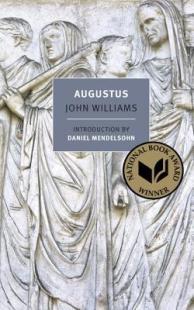
 I have been studying the ancient world for the better part of 25 years, having taken and taught countless history, mythology and literature classes. Like every good student I have familiarized myself with important people, events, dates, etc. But nothing has given me the experience of Ancient Rome and the Emperor Augustus quite like reading John Williams historical fiction about Augustus.
The style of this book is epistolary, whereby we learn about Augustus through the letters of those people who were most important in his life. In Book I, Octavian, not quite yet The August, is in Apollonia with his closest friends, Marcus Agrippa, Gaius Maecenas and Salvidienus Rufus practicing his military skills and honing his philosophical abilities when he gets the word that his uncle Julius Caesar is murdered. This young man, at the age of 19, stands at a significant crossroad in life and must decide either to also be swallowed by his uncle’s enemies, or to embrace a position of power and leadership. Luckily for Rome he chose the latter.
Octavian returns to Rome where Mark Antony is rude and dismissive to the young man who is the heir of Julius Caesar’s fortunes. Although Octavian and Antony mistrust each other and view one another as rivals, they form an uneasy peace in order to avenge the death of Julius Caesar. Williams depicts the men sitting in a primitive hut as they write proscription lists in order to eradicate everyone who was involved in Caesar’s assassination. Cicero, the famous orator himself, who opportunely plays both sides, is also one of their victims and his head and hands are displayed on the rostra in the Roman Forum.
Through the condescending jabs and insults that Octavian and Antony throw at each other, Williams brilliantly foreshadows the civil war that erupts between Octavian and Antony. When Antony is on campaign in the east and marries Cleopatra, the fragile peace that exists between them is shattered. Throughout Book I, Octavian is never portrayed as a vengeful, warmongering military man, but instead he is viewed by his friends as someone who is doing the best he can to ensure peace and stability for Rome. Maecenas states in one of his letters that Octavian did not wish Cleopatra dead and, in fact, he thought she would have made a great administrator and could have kept titular control over Egypt.
My favorite part of the novel was Book II in which we hear from Augustus’ daughter, Julia. Julia is the only biological child of the Emperor and she gives us the image of a man who adores and dotes on his only child. However, as Julia becomes older she is called on by her father to fulfill her duty to Rome through various marriages that are advantageous to the Empire’s political stability.
First, Julia is married to Marcellus, Augustus’ nephew and heir-apparent. When Marcellus dies at the tender age of 19 from a sudden fever, Julia is then given in marriage to Agrippa, Augustus’ long-time friend and second in command. Julia bore him 5 children and her time with Agrippa is some of the happiest in her life. However, when Agrippa dies, Julia is forced to marry Tiberius, her father’s stepson, who is despised by the emperor because of his cruelty and brutality. When she takes a lover of her own choosing, this decision leads to her downfall and lonely exile far away from Rome. Julia’s letters are emotional, reflective and even philosophical as she contemplates her role in the legacy of Rome and the fact that woman of her rank have no control over their own circumstance.
In the final part of the book we actually hear from the Emperor himself when, in the last days of his life, he writes to his friend Nicolaus of Damascus. At this point Augustus talks about his legacy and the peace and stability that he has bequeathed to Rome. He worries for his empire’s future, especially because of the German barbarians who always threaten invasion from the North. He remembers some of his old friends, especially the poets Vergil, Horace and Maecenas with whom he found true friendship. Finally, he ponders the ephemeral nature of this life and realizes that no matter what he has done to ensure Roman peace and prosperity, his empire will not and cannot last forever. Williams’ Augustus becomes for us the literary symbol of all leaders who struggle to deal with power, fame, fortune, strife, decision-making and the plethora of other responsibilities that weigh on them so heavily.
I do not use rhetorical hyperbole when I write that this novel is a brilliant work of literary genius. It is John Williams crowning achievement. What better way to commemorate the 2000th anniversary of Augustus’ death on August 19th than by spending a little time with the Emperor between the pages of Williams’ novel.
I am eternally grateful for The New York Review of Books for sending me an Advanced Copy of this novel.


 This collection of short stories is divided into four sections, the first of which is entitled “The Listener” and was originally published in 1971. I found the stories in this part of the collection to have a dream-like, almost surreal quality to them. In the story that is the title to the collection, “The Listener”, a woman who is called Aunt Gerda has always been a great listener to her family. She listens intently to all of their stories and woes and when she is about fifty-five years old her personality starts to change. She seems to forget names and people and starts to spend a lot of time by herself.



 The Book Binder's Daughter