Sorting the Stacks: Recent Photos of my Bookshelves

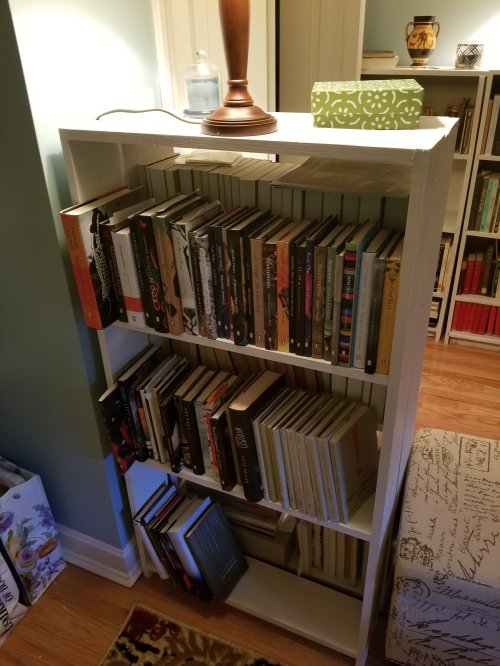
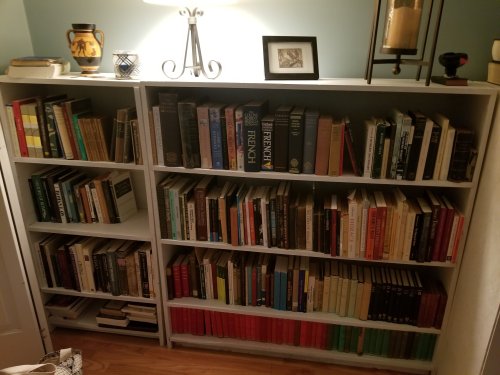
It took me three full days, but I finally reorganized my books. The piles in the living room were really getting out of hand and it was annoying to me how cluttered my collection was getting. On the first day of culling and sorting when most of my books had been pulled off the shelves and stacked into various piles around the house I wanted to give up, lie on the floor and cry. But I pressed on and am very happy with the results.

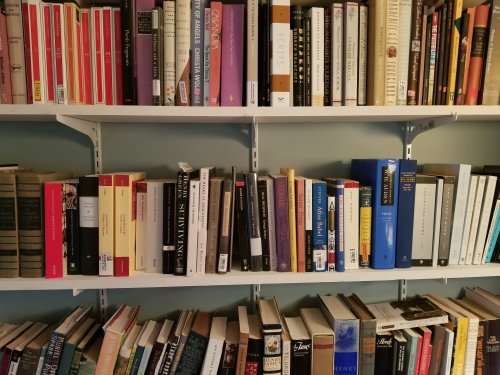
NYRB books and Fitzcarraldo editions

In a post a while back I discussed the conundrum of how one goes about organizing a large collection of books. Some do alphabetical, some sort by publisher and I’ve even seen a few organize books by color. I decided to go by nationality.

Top shelf are some German and French books, middle shelf is British lit and bottom shelf is American lit.

Well, mostly by nationally, I should say. I have a British section, an American section, a German section, etc. But I kept the Seagull books together as well as the NYRB books and a few other special publishers whose books I collect. I also have special sections dedicated to poetry, letters/memoirs, and essays.

Seagull books collection

This means that the Christa Wolf books are in the German section, except for her three books which are Seagull publications. So it’s definitely not a perfect system.

Persephone, Virago, and Classic Penguins

And the massive amount of classics books which are kept together have their own classification: Latin, Ancient Greek, Roman History, Greek History, Archaeology, etc., etc.

How do you sort your books?

33 Comments

Filed under Uncategorized

Zosima’s Rotting Corpse: More Thoughts on The Brothers Karamazov

I keep thinking about Alyosha’s test of faith in The Brothers Karamazov when his mentor, Father Zosima dies.  This monk is considered an elder in his monastery—the word staret is used for him in the Avsey translation—with special powers of healing, prophesy and spiritual guidance.  People flock from all around for the privilege of approaching this monk, similar in my mind to worshippers visiting the god Apollo’s Oracle at Delphi; they seek healing—-one woman brings her crippled daughter, they ask advice—-another woman questions whether or not she should hope that her son, a soldier, is still alive, and they look for spiritual guidance—a mother worries about the soul of her deceased child.  All of these people, some of the other monks included, who so highly praised Father Zosima during his life of service, are bitterly disappointed when, only a few hours after his death, his body begins to rot and putrefy in his coffin.  This entire episode displays Dostoevsky’s brilliance in creating a religious dilemma that shines a light on those who are truly spiritual versus those who are merely superstitious.

Those who believed in Father Zosima’s powers as a staret gather around the monastery expecting miracles to happen after his death but instead that get a rotting corpse.  They become angry and question his entire religious life as that of a highly respected elder.  Some of the other monks who were jealous of Zosima’s elevated status among them are secretly happy that the dead monk’s body is starting to stink.  Alyosha, too, was hoping for miracles and awe inspiring events to occur when his mentor died because this holy man truly deserved to recognized as a great religious leader.  But Alyosha’s anger is different than the other onlookers because his is one of indignation at the insults being thrown around about his dead mentor.  The decaying and fetid corpse is the perfect metaphor for Dostoevsky to deal with the darker sides of the human soul; in this central piece of the story, after lingering for many chapters on the extraordinary religious journey of this holy man, he uses the end of his physical life to expose the rot in the spirits of these so-called believers.  The very minute these worshippers are disappointed and don’t get what they want, their opinion of someone they revered turns bitter and ugly.

One of my favorite narrative techniques is when Dostoevsky uses the first person to address his audience and this is employed at great length to describe Alyosha’s spiritual turning point in the novel.  Dostoevsky feels a great need to explain that his hero’s crisis of faith and reaction to Zosima’s rotting body is very different from everyone else’s  This is Dostoevsky, I think, at the pinnacle of his writing:

You see, even though I stated earlier (all too hastily, perhaps) that I would not offer any explanations, excuses or justifications on behalf of my hero, nevertheless I realize that some clarification is called for in order to understand properly the story that is to follow.  Let me put it this way: it was not just a question of miracles.  It was by no means a case of frivolous expectation of the miraculous.  Alyosha needed miracles neither to confirm any particular convictions of his (that least of all) nor to bolster the triumph of any deep-seated, preconceived theory over other theories—not that either; in his case I was first and foremost a question of love and veneration of one individual person, that and nothing else—the person of his beloved starets, his mentor.  The point to bear in mind is that at that particular time and throughout the whole of the preceding year, all the love that he had borne in his pure young heart towards ‘all and sundry’ had appeared on occasion and particularly at times of spiritual crisis to be concentrated, however mistakenly, on one single individual, that is on his beloved starets, who was now dead.  In fact, this being had been an unquestionable paragon for him for so long that all his youthful energy and all his aspirations were channeled perforce towards that same paragon, on occasion even to the exclusion of ‘all and sundry.’

And Dostoevsky continues:

But again it was not miracles he needed; rather, some ‘supreme justice’ that he believed had been violated, and as a consequence of which violation his heart had been so cruelly and unexpectedly wounded.  Is it any wonder, therefore, that by the very nature of things Alyosha should expect this ‘justice’ to take the form of the instant miracle expected from the bodily remains of his beloved erstwhile teacher?  After all, this was just what everyone at the monastery thought and expected, even those whose intellect Ayosha venerated—Father Paisy, for instance—and hence Alyosha, untroubled by the least doubt, had begun to nurture the same dreams.  He had long since accepted in his heart, a year’s life at the monastery had accustomed him to such expectations.  But it was justice he yearned for, justice, and not just miracles!

What will Alyosha learn from this wounded heart and will he lower his expectations?  How will Alyosha apply all of these lessons outside of the monastery when his faith and his morals are truly tested?  Dostoevsky seems to be hinting that, unlike others, his hero will come out stronger and perhaps even get the justice he is seeking.


 

1 Comment

Filed under Classics, Russian Literature

I Can Remember Still the Sun: A Poem by Gamel Woolsey

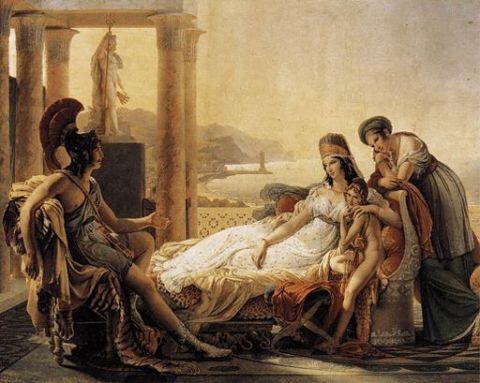
Dido and Aeneas. Pierre-Narcisse Guérin. Oil on canvas, c. 1851.

Gamel Woolsey uses one of Vergil’s most famous lines from The Aeneid as inspiration for her imposing yet brief poem:

“Forsan et Haec Olim Meminisse Iuvabit”
(“Perhaps one day it will be a pleasure to remember even this…”)

Why should you feel remorse, regret,
For what was beautiful to me,
As uncommanded as the sea?
The winds blew and the waters sang
All summer: now that summer’s done
I can remember still the sun
That lay upon the mountain grass,
And all the beauty that there was –
Only remember what was fair,
And what was wild and innocent;
The rest is blown upon the air.

Woolsey was born in South Carolina in the United States and lived in New York City for a while before moving permanently to England.  Her love affair with Llewelyn Powys prompted her to take up residence near him in Dorset.  She later married writer Gerald Brenan and they lived together in Spain and England until her death in 1968.

While visiting my favorite bookshop in Maine I came across one of Woolsey’s novels, One Way of Love,  published posthumously in 1987 by Virago Press.  I am hoping to read it before the end of summer.

6 Comments

Filed under Uncategorized

Breaking and Beginning Again and Again: Simone de Beauvoir on Giacometti

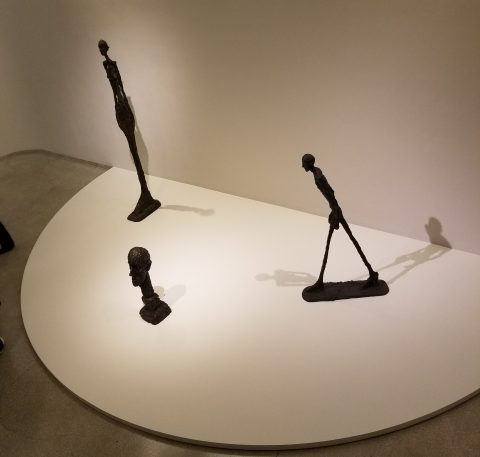
Tall Woman IV, 1960-61, Bronze; Monumental Head, 1960, Bronze; Walking Man I, 1960, Bronze.

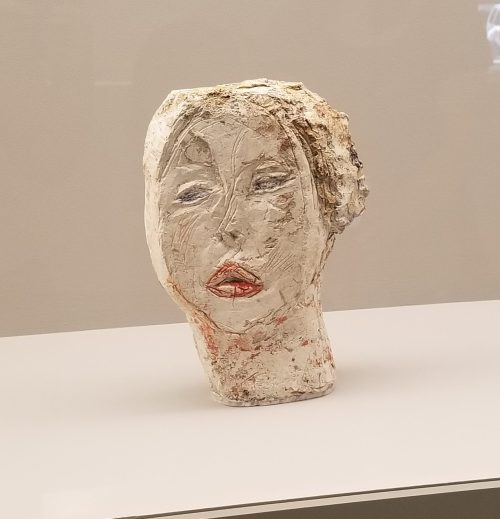
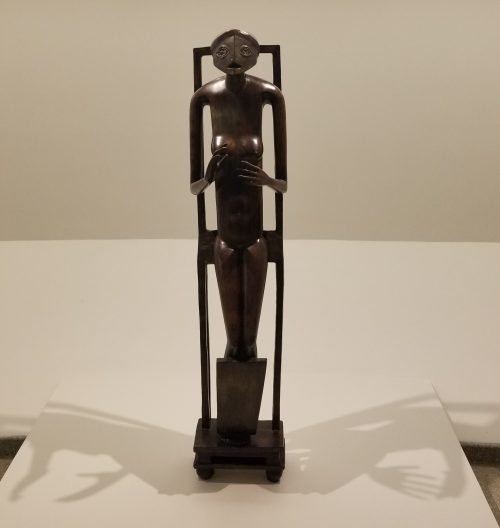
Last month I visited the fantastic Giacometti exhibit currently on at the Guggenheim.  I was exhausted, in a good way, after spending hours viewing his sculptures, sketches and paintings. I was fondly reminded of the exhibit when, this weekend, I started reading a collection of letters written by Simone de Beauvoir to her lover Nelson Algren.  In a letter dated the 5th of November, 1947,  she describes Giacometti’s messy studio and slovenly personal habits as well as his rejection of money and fame in favor of artistic integrity.  I was so amused by her candid portrayal of his artistic process and his private life:

I don’t think I happened to speak about a very good friend of us who is a sculptor, though we see him often and he is maybe the only one we always see with pleasure.  I tried to describe him partly in Le sang des autres.  I admire him as an artist immensely.  First because he does the best modern sculpture I know; then because he works with so much purity and patience and strength.  He is called Giacometti, and will have a big exhibition of his works in New York next month.  Twenty years ago he was very successful and made much money with a kind of surrealistic sculpture.  Rich snobs payed expensive prices, as for a Picasso.  But then he felt he was going nowhere, and wasting something of himself, and he turned his back on snobs; he began to work all alone, nearly not selling anything but just what was wanted to live.  So he lives quite poorly; he is very dirty in his clothes.  I must say he seems to like dirt: to have a bath is a problem for him.

Head of a Woman, 1926, Painted Plaster.

Yesterday I saw his house and it is dreadful.  In a nice little forgotten garden, he has an atelier full of plaster where he works, and next door is a kind of hangar, big and cold, without furniture nor store, just walls and roof.  There are holes in the roof so the rain falls on the floor, and there are lots of pots and pans to receive it, but there are holes in them too!  He works 15 hours a day, chiefly at night, and when you see him he has always plaster on this clothes, his hands and his rich dirty hair; he works in cold with hands freezing, he does not care.  He lives with a very young girl whom I admire much for accepting his life; she works as a secretary the whole day, and coming back just finds this hopeless room.  She has no coat in winter and shoes with holes in them.  She left her family and everything to come to Paris and live with him; she is very nice.   He cares much for her but he is not of the sweet kind at all, and she has some hard moments to get through.  What I like in Giacometti chiefly is how he could one day break into pieces all that he had done during two years: he just broke it and his friends thought it dreadful.  He has his idea about sculpture, and for years he just tried and tried, like a maniac, not show anything, breaking and beginning again and again.  And he could easily have got money and praises and a good name.  He has very peculiar, interesting ideas about sculpture.  Well, I think that now he really achieved something; I was deeply moved by what I saw yesterday.

Hands Holding the Void, 1934, Bronze.

6 Comments

Filed under Art, Letters

A Colossal Drama: The Brothers Karamazov by Dostoevsky

Set design for The Brothers Karamazov for Jacques Copeau’s Théâtre du Vieux-Colombier by Louis Jouvet.

I found it a bit baffling at first that my reading experiences with  The Brothers Karamazov and War and Peace have been equally sublime and edifying even though they are written in such different styles.  I couldn’t quite grasp the difference between these novelists until I read George Steiner’s essay Tolstoy or Dostoevsky in which he compares the narrative of Tolstoy’s novels to epic and Homer and Dostoevsky’s to tragedy and drama.  For my mind these are the perfect analogies to describe the uniqueness of these Russian greats:

…More, perhaps, than those of any novelist of comparable dimension, Dostoevsky’s sensibility, his modes of imagination, and his linguistic strategies were saturated by drama.  Dostoevsky’s relationship to the drama is analogous, in centrality and ramification, to Tolstoy’s relationship to the epic.  It characterized his particular genius as strongly as it contrasted it with Tolstoy’s.  Dostoevsky’s habit of miming his characters as he wrote—like Dickens’s—was the outward gesture of a dramatist’s temper.  His mastery of the tragic mood, his “tragic philosophy,” were the specific expressions of a sensibility which experience and transmuted its material dramatically.  This was true of Dostoevsky’s whole life, from adolescence and the theatrical performance recount in The House of the Dead to his deliberate and detailed use of Hamlet and Schiller’s Räuber to control the dynamics of The Brothers Karamazov.  Thomas Mann said of Dostoevsky’s novels that they are “colossal dramas, scenic in nearly their whole structure; in them an action which dislocates the depth of the human soul and which is often packed into a few days, is represented in surrealistic and feverish dialogue…” It was recognized early that these “colossal dramas” could be adapted to actual performance; the first dramatization of Crime and Punishment was produced in London in 1910.  And referring to the Karamazovs, Gide remarked that “of all imaginative creations and of all protagonists in history none had been claims to being presented on a stage.”

When we read Aeschylus’s Agamemnon, we are not just experiencing the events of a day in the life of this father, son, husband and king; but we are witnessing all of the character traits of the House of Atreus, good and bad, that have seeped into his blood and his soul.  We are also given a hint as to the nature of his son’s soul which has equally been affected by these familial ties.  Similarly, in The Brothers Karamazov, Dostoevsky immediately launches us into a detailed account of the father, Fyodor, and his history of drunken and sexual debauchery.  And anytime one of his sons drinks excessively, seduces a woman, or is quick to anger Dostoevsky reminds us that this is a characteristic of a Karamazov.  I am not quite half way through the book yet, but I suspect that the inability of one or more of his sons to break from the father’s soul-destroying patterns will result in tragedy.

7 Comments

Filed under Classics, Essay, Russian Literature