Category Archives: French Literature

Aline & Valcour Volume 2 by Marquis de Sade

In a letter written from prison to his wife in 1784, Marquis de Sade complains about his discomfort and what he perceives as his ill treatment:

You are also well aware that my dizzy spells and my frequent nosebleeds, both of which I have when I’m not lying down with my head perched extremely high, had obliged me to have an oversized pillow. When I tried to take this wretched pillow with me, you would have thought I was trying to steal the list of those who had conspired against the State; barbarically, they tore it from my hands and declared that matters of such magnitude had never been tolerated.  And indeed I realized that some secret rule or regulation of government doubtless stipulated that a prisoner’s head should be kept lowered, for when to remedy that situation owning to the fact that my oversized pillow had been denied me I humbly requested four planks of wood, they took me for a madman. A swarm of commissioners descended upon me, who, having verified that I was indeed most uncomfortable in bed, in their infinite wisdom concluded that the rules were the rules and ’twas impossible to change them. Verily I say unto you that that you have to see it to believe it, and were we to learn that such things were taking place in China, our tender and compassionate Frenchmen would wast not a moment shouting to the high heavens: Oh! those barbarians!

Marquis de Sade wrote Aline & Valcour during this same period of time while locked up in the Bastille, one of the many incarcerations he would suffer through in his life.  The second volume of this book, as it is published by Contra Mundum Press, becomes more deeply introspective and philosophical as Sade’s incarceration is obviously wearing on him.  The eponymous characters of the story are completely absent from this long interlude.  Instead it involves the story of Sainville and Leonore, two lovers that are similarly kept apart by their parents and a series of terrible accidents.  The pair, just recently reunited, spend the night at Aline’s family’s home and tell their long, sad tale.

Sainville and Leonore elope and are spending their honeymoon in Venice when Leonore is kidnapped by a crazy Italian count who wants to keep her as his sex slave.  Sainville travels to Africa and parts of the south seas in the hopes of finding her and he visits two very different countries, one a savage, barbaric tyranny and the other a beautiful, peaceful utopia.  These two very different places allow Sade to reflect on political philosophy, religion, the treatment of women, and the nature and rights of man.  In Africa, King Maacoro of Butua is a tyrant who uses women for sex, domestic work and heavy labor.  He eats the flesh of his captured enemies as well as women who are sacrificed to the country’s savage deities.  Sarmiento, a servant of the King explains the horrible conditions under which women live in this place:

It is impossible to describe, my friend, the subjugation of women in this country. To possess many of them is a luxury but made little use of. Whether rich or poor, men think as one on the matter. Females are worked here like our beasts of burden in Europe. They sow and plow the fields and harvest the crops; in the house they clean and serve and, in addition, they are offered up to the gods and immolated. They are perpetually faced with the men’s ferocity and barbarism and become victims of their ugly moods, intemperance and tyranny.

We are meant to be horrified, I think, at the barbarism of the men in this place and particularly at the way in which women are used as chattel.  I was surprised, given Sade’s reputation and his other writings, to find that he thinks women should be treated properly and respectfully by men.  In his own letters he is abusive and angry towards his own wife, but apparently he doesn’t feel that it is appropriate for all women to be treated so harshly.

By contrast, in the kingdom of Zame, where Sainville lands next, women are treated as equals among men.  In this utopia, all worked together to produce goods and services to that all citizens are happy and get what they need.  The description of this kingdom is very Marxist and Socialist in nature. And it is Zame who Sade uses at his mouthpiece for condoning unnecessarily harsh laws and prison sentences:

Don’t you know that prison, the worst and most dangerous of punishments, is nothing but an ancient abuse of justice, and that despotism and tyranny follow in its wake? The necessity to keep in custody one who shall be judged led naturally first to the invention of irons, maintained under barbarism. That atrocity, like any act of severe rigor, was born of ignorance and blindness. Inept judges, daring neither to condemn nor absolve, would often prefer to keep the accused in prison, conscience clear because they don’t take the life of the man but neither do they return him to society.

Sade also continues to be influenced by Lucretian and Epicurean philosophy.  As Sainville is looking for his wife and is constantly suffering shipwrecks and other horrible misfortunes, he invokes the name of Lucretius:

Here a philosopher might profit from the study of man, observing with what rapidity a change in atmosphere drives him from one state to another. An hour ago our sailors were drunk and cursing. Now they raised their hands to implore Heaven’s protection. Fear is truly the wellspring of religion and, as Lucretius said, the mother of all cults. Were man gifted with a better constitution and a nature less prone to disorder, we’d never hear talk of gods on earth.

It’s in the context of religion that Sade brings up Lucretian thoughts again, but this time it is curious that this speech comes from the mouth of his villain in the Kingdom of Butua.  The religious rites of these people are brutal and barbaric and they also believe in the materialism of the soul and the death of it once it is detached from the body—a major tenet of Lucretian philosophy.  Sarmiento once again explains to him, “Their notions concerning the fate of souls in the afterlife are quite confused. First of all, they don’t believe the soul is distinct from the body; they say it’s only the result of the way we are organized by Nature. Each type of organization necessitates a different soul and that is all that separates us from the animals. Their system seems to me quite philosophical.”

But why attribute this philosophy to those who live in the dystopia instead of the utopia?  The fate of the soul and the afterlife are never discussed with Zame.  Perhaps these are ideas that intrigued Sade, but ones that he couldn’t quite accept as his own personal belief system?  The second volume, although it veers from the main story, is just as, if not more, intriguing and thought-provoking as the first.

On to Volume III.
 

17 Comments

Filed under Classics, French Literature

Reading The Stranger via Camus’s Notebooks

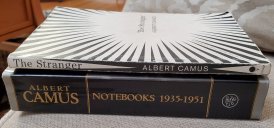
The Stranger was one of those books I read at eighteen that left almost no impression on me.  I’ve had no desire to revisit any of Camus’s writing until recently when a friend, who is one of the most astute readers I know, recommended reading some of Camus’s other, less well-known, writing.  For the past week or so I have been captivated by Camus’s 400 pages of Notebooks that span the years 1939 through 1951.  He includes vivid descriptions of scenery, personal reflections, ideas for new novels and plays and his philosophical views on life, death, love and art.  In an entry from 1942, Camus writes a response to a negative review of The Stranger which he never sends.  It is the response to his critic which inspired me to reread The Stranger this week alongside the Notebooks. 

Of course a lot has been written about Meursault’s taciturn nature and the fact that he only speaks when answering direct questions.  On this reread what stood out to me most was Meursault’s inner strength, especially when settling into life in a small prison cell.  Typical for anyone incarcerated he misses his freedom, seeing and interacting with nature, and women.  But he settles into a routine that gives him comfort and he remembers an important bit of advice his mother gives him (trans. Matthew Ward):

I waited for the daily walk, which I took in the courtyard, or for a visit from my lawyer. The rest of the time I managed pretty well. At the time, I often thought that if I had had to live in the trunk of a dead tree with nothing to do but look up at the sky flowering overhead, little by little I would have gotten used to it.  I would have waited for birds to fly by or clouds to mingle, just as here I waited to see my lawyer’s ties and just as, in another world, I used to wait patiently until Saturday to hold Marie’s body in my arms. Now, as I think back on it, I wasn’t in a hollow tree trunk. There were others worse off than me. Anyway, it was one of Maman’s ideas, and she often repeated it, that after a while you could get used to anything.

Camus often writes about death in his Notebooks and believes that the only way to attain true liberty in this life is to free oneself from a fear of death.  His protagonist hopes for a stay of execution but eventually accepts his fate, without the help of the prison Chaplain who is utterly annoyed with the prisoner’s disinterest in God.  In one final speech at the end Meursault reflects on his argument with the Chaplain and the absurdity of life:

It was as if I had waited all this time for this moment and for the first light of this dawn to be vindicated. Nothing, nothing mattered and I knew why. So did he. Throughout the whole absurd life I’d lived, a dark wind had been rising towards me from somewhere deep in my future, across years that were still to come, and as it passed, this wind leveled whatever was offered to me at the time, in years no more real than the ones I was living.  What did other people’s deaths or a mothers’ love matter to me; what did his God or the lives people choose or the fate they think they elect matter tome when we’re all elected by the same fate, me and billions of privileged people like him who also call themselves my brothers?

Camus’s own description of Meursault in the Notebooks (1942) are enlightening, to say the least, and completely changed the way I view Camus and his most famous novel (trans. Philip Thody):

It’s a very studied book and the tone…is intentional. The tone is heightened four or five times, to be sure, but this is to avoid monotony and to provide composition. With the Chaplain, my Stranger does not justify himself. He gets angry, and that’s quite different. I’m the one to explain then, you say? Yes, and I thought about that considerably. I made up my mind to this because I wanted my character to be led to the single great problem by way of the daily and the natural. The great moment had to stand out.

One final side note, I am also reading Sade and thinking about Lucretius and Epicureanism.  I see some of these same thoughts and threads in Camus—dispelling the fear of death, deity as a distant figure that cares nothing for humans, the random absurdity of the universe. Camus writes about Lucretius and Sade in his Notebooks.  A wonderful reading coincidence for me.

10 Comments

Filed under Classics, French Literature

We Mislead, but Sweetly: Aline & Valcour, Volume I by Marquis de Sade

This is the first English translation, expertly and smoothly rendered from the French by Jocelyne Genevieve Barque and John Simmons,  of Marquis de Sade’s epistolary novel.  Written in 1786 while he was locked in the Bastille, this book is very different from Sade’s later, more pornographic, writings.  Contra Mundum Press has, wisely, decided to break up the novel into three volumes—easier to carry and nicely displayed on one’s shelves.  My impressions of the first volume are ones of astonishment—at the riveting adventure story, the slowly unraveling mystery, and a philosophical statement on Epicurean/Lucretian philosophy.
Aline and Valcour are young lovers kept apart by Aline’s vicious and depraved father, President Blamont,  who wants to pawn her off to his equally sadistic friend, Monsieur Dolbourg.  Blamont and Dolbourg take extreme pleasure in keeping young women as sex slaves and doing unspeakable things to them—although, as I mentioned, Sade’s descriptions of these debaucheries is minimal compared to his later writing.   The mental and physical pain that Blamont causes for his wife, daughter, and victims is a theme that occurs constantly in the letters and his choice of epistolary style allows Sade to struggle with the concepts of pain and pleasure on a philosophical level.  Madame Blamont writes to Valcour :

Can I justly pretend to some perfect happiness?  Does it exist anywhere beneath the heavens above? To be put on earth to suffer is the simplest thing in the world.  Are we not here as gamblers around the table? Does Dame Fortune favor everybody seated there? By what right dare they accuse her of squandering their gold instead of winning it?  The hand of the Eternal One suspends above our heads good and evil in equal portions and they spill indifferently upon us.  I might have been happy just as, so it happens, I’m miserable—a question of chance.  And the greatest fault of all is to complain.  Moreover, can’t we imagine taking pleasure even in extreme unhappiness? But dint of sharpening our soul, unhappiness intensifies sensitivity; its impressions, by developing in a more vigorous way all manner of feeling, bring about pleasure unknown to those who are cold-hearted and unfortunate enough to have experience only tranquility and prosperity.

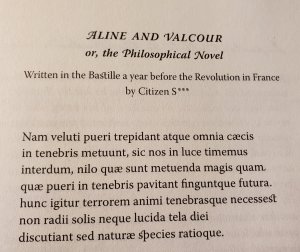
Sade’s vision of a deity is Epicurean in the sense that this being is indifferent to our fmisortunes.  Pain and pleasure for Sade are very closely related and one cannot experience happiness without first being exposed to extreme forms of pain.  Does Sade see his novel as didactic, as a way of teaching us this lesson?  Is he trying to dispel our fears of pain and death?  The epigram that Sade writes at the beginning of Aline & Valcour in which he quotes Lucretius, De Rerum Natura, 2.55-61 gives us a a small clue (this translation is my own; in the Contra Mundum version, the authors use R.C. Trevelyan’s 1937 translation):

Just as small children tremble and fear everything in the blind darkness, so do we, as adults, fear in broad daylight things that are just as irrational as the fears of children in the dark when they imagine things before their eyes. Therefore, it is necessary for us to shake off this terror and gloom of the mind, not by the rays of the sun or the brightness of daylight, but by the appearance and reason of nature.


Lucretius sees poetry as a way of tricking people into dispelling their fear of pain and death.  In his most famous metaphor, poetry is the honey we rub on the edge of a bowl in order to coax a child into  taking his bitter medicine.  One other, quite obvious allusion, to Lucretius in Aline & Valcour also gives us a clue as to Sade’s philosophical motivations with his writings.  Once again, it is Madame Blamont that writes to Valcour on behalf of herself and her daughter:

I ought not to have allowed you to come to know Aline or her unfortunate mother; today, we would certainly all have less pain; and for the pain we inflict upon others we can never be consoled.  But all is not lost—no, Valcour, not all. My barbaric husband, who torments you so, might yet reconsider, so too the ridiculous monster who trails his every step. It might dawn on him that he’ll reap non of the hoped-for pleasure from she who hates him so. That much, at least, I can only hope and believe, though I know illusion is to unhappiness as honey rubbed round the rim of a glass of absinthe, offered to a child in pain: we mislead, but sweetly.

Sade, however, has a more sinister view of this deception.  How much is an author or philosopher really fooling anyone with this “honey?”

Will the lovers eventually be together?  Will Blamont’s victims escape his torments?  And who are the mysterious house guests that appear at Madame Blamont’s at the end of Volume I?  These plot considerations as well as Sade’s philosophical threads have me eagerly reading Volume II.


11 Comments

Filed under Classics, French Literature

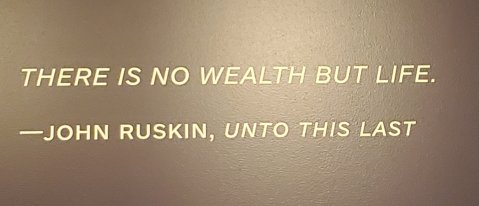
There is no Wealth But Life: Ruskin at the Yale Center for British Art

Proust’s translation of Ruskin’s Sesame and Lilles.

In a letter to his English friend, Marie Nordlinger, dated January 1900 Proust writes (trans. Mina Curtiss):

On learning of Ruskin’s death, I cannot keep from thinking of you so poignantly that I must write to you. Not that it needed this to make me think of you. Having been ill for several days, unable to write easily and unwilling to dictate a letter to you, all mo most friendly and grateful thoughts of you, of your letter, of the book [Queen of the Air, by John Ruskin] you sent with its even more precious annotations, are lodged in the very forefront of my being, not in that secluded part of oneself that one visits only rarely, but in that intimacy of the heart where we meet each other several times a day. But when I learned of Ruskin’s death, I wanted to express to you before anyone else, my sadness, a healthy sadness, however, and indeed full of consolations, for I know how little death matters when I see how powerfully this dean man lives on, how much I admire him, listen to him, try to understand him, to follow him more than I do man of the living.

Proust began reading Ruskin in 1897 and translated two of his texts: The Bible of Amiens in 1904 and Sesame and Lilles in 1906 and also contributed prefaces to each book. Over the Thanksgiving holiday, while visiting family in the New Haven area, I was able to see the Ruskin exhibit at the Yale Center for British Art which is on until December 8th. I was eager to see what Proust admired in this author, artist and critic and came away with a much greater appreciation for Ruskin.

The exhibit begins with one of Turner’s paintings of Venice (the museum also has quite a nice collection of Turner in its main gallery) which inspired Ruskin not only to defend Turner’s work but also to write a three volume history of the city, The Stones of Venice.

Turner. Venice, from the Porch of Madonna della Salute. 1835. Oil on Canvas.

Ruskin. The south side of the Basilica of St. Mark’s from the Loggia of the Doge’s Palace, Venice. 1850-52. Watercolor over pencil, heightened with gouache.

My favorite parts of the exhibit were, no surprise, the books and notebooks on display. The collection of Ruskin’s first edition books was impressive, many of them borrowed from the nearby Beinecke Rare Books library. Here are few of Ruskin’s personal notebooks with drawings and sketches:

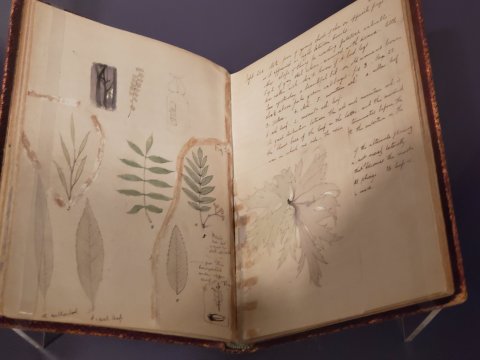
Ruskin. Manuscript notebook with watercolors, sketches and drawings. 1842

Ruskin Notebook containing a partial manuscript of The Ethics of Dust. 1865

I also enjoyed Ruskin’s attempts to replicate 5th century Ancient Greek red figure paintings:

Ruskin. Owl after and Attic Kantharos. 1870. Pen and black ink and watercolor on paper.

The Ruskin exhibit is absolutely worth a trip if you are anywhere near the New Haven area. The gallery also has a fabulous collection of British Art from various eras. I lingered for a while on the upper floors looking at their Turners and the few Blakes that they have. One can easily spend half a day looking at this gem of a gallery in the heart of New Haven. The Yale Art Gallery is also across the street and the Beinecke Rare Books library is a short walk. And New Haven abounds with fantastic cuisine. New Haven is the place of my birth and where I lived until the age of 18. It’s interesting to think about how a city evolves in one’s memories and impressions.

13 Comments

Filed under Art, British Literature, French Literature, Letters

The Various Stages of a Voyage: The Book of Laughter and Forgetting by Milan Kundera

It took me about fifty pages of Kundera’s book (in Aaron Asher’s translation from the French) before I was drawn in and absorbed with it. The seven chapters of the book are more like short stories which are loosely tied together by theme. The Book of Laughter and Forgetting has been described as a novel and, at times, autobiographical. But, like many great authors who invent their own genres of writing (Musil, Proust, Kafka, etc.) Kundera instructs us on how to read him:

This book is a novel in the form of variations. The various parts follow each other like the various stages of a voyage leading into the interior of a them, the interior of a thought, the interior of a single, unique situation, the understanding of which recedes from my sight into the distance.

It is a novel about Tamina, and whenever Tamina goes offstage, it is a novel for Tamina. She is its principal character and its principal audience, and all the other stories are variations on her own story and meet with her life as in a mirror.

It is a novel about laughter and about forgetting, about forgetting and about Prague, about Prague and about the angels.

Like the author himself, Tamina lives in exile in another country in the west after she escapes political persecution by the Communist government in Prague. Shortly after their escape, Tamina’s husband dies and she leads a very lonely, monotonous, and silent existence. As the years slip by she is worried that her memories of her life with her husband are fading as well. She is desperate to somehow retrieve her notebooks and diaries which she left in Prague.

For Tamina is adrift on a raft and looking back, looking only back. Her entire being contains only what she sees there, far behind her. Just as her pas contracts, disintegrates, dissolves, so Tamina is shrinking and losing her contours.

She wants to have her notebooks so that the flimsy framework of events, as she has constructed them in her school notebook, will be provided with walls and become a house she can live in. Because if the tottering structure of her memories collapses like a clumsily pitched tent, all Tamina will be left with is the present, that invisible point, that nothingness moving slowly toward death.

Throughout the book I kept thinking about memory and how our minds choose what to keep and what to discard. Even with important or traumatic events our memories can’t possibly retain every detail. Christine Blasey Ford’s testimony about the Supreme Court nominee comes to mind: “indelible in the hippocamus is the laughter” is the horrifying detail she remembers when Kavanaugh and his friend attempted to assault her. Tamina doesn’t have the opportunity to get her diaries back but she learns that there are some parts of her memory, even though they are fragments—good or bad, that she will always have with her.

One final word about Kundera’s astonishing piece of writing is the eroticism that pervades every chapter. Orgies, menage a trois, assault, casual sex, etc. are among the acts that are described in the narrative. It was an odd theme that stands out among the others for me. But I don’t know enough about Kundera’s style and other writings to make any intelligent comments about it. So I will simply mention that it’s there and keep processing it as I read more of his fiction and non-fiction. Do you have a favorite Kundera? Please do let me know!

14 Comments

Filed under French Literature