Tag Archives: Historical Fiction

Review and Giveaway: Rodin’s Lover by Heather Webb

My Review:
02_Rodin's LoverThis novel moves back and forth between the points of view of the famous French artist Auguste Rodin and his lover Camille Claudel.  They meet when Rodin becomes Camille’s teacher; she eventually is taken on as his apprentice and as a result they spend hours together working side by side.

The aspects of this book I like the most are the details about art, sculpture and the creative process.  One only sees the beautiful finished works of great artists in museums, but what one doesn’t see is the hard work, sacrifice and dedication behind these works.  Rodin and Camille are dedicated to their craft to the point where they no time for anything else and alienate other people in their lives.  The reason they are drawn together is that no one understands them like they understand each other.

There are a couple of issues that I did have with the book; some of the dialogue became monotonous, especially when Camille was arguing with her mother.  There is no affection or love between mother and daughter and they are constantly bickering.  Also, I would categorize the book as a light romance and the two lovers spend a lot of time thinking about and longing for each other but not actually together.  This is the case especially in the first half of the book which I found to lag more than the second part of the book.

Overall, RODIN’S LOVER is an interesting look at this famous artist and his process and inspiration.  Scroll down to the end of the post to win your own copy of the book!

About The Author:
01_Heather WebbHeather Webb grew up a military brat and naturally became obsessed with travel, culture, and languages. She put her degrees to good use teaching high school French for nearly a decade before turning to full time novel writing and freelance editing. Her debut, BECOMING JOSEPHINE, released January 2014 from Plume/Penguin. Her forthcoming novel, RODIN’S LOVER, will release in winter of 2015.

When not writing, Heather flexes her foodie skills or looks for excuses to head to the other side of the world.

Giveaway:
This giveaway is for one paperback and open to US & Canadian residents only. Giveaway ends 2/13. Please leave a comment below and let me know you want to win!
Rules:
– Must be 18 or older to enter.
– Giveaway is open to US & Canadian residents only.
– Only one entry per household.
– All giveaway entrants agree to be honest and not cheat the systems; any suspect of fraud is decided upon by blog/site owner and the sponsor, and entrants may be disqualified at our discretion.
-Winner will be notified via e-mail and will have 48 hours to respond.

Click on the tour banner below to see all of the stops on the book tour.  There are other chances to win the book and interviews with the author!

03_Rodin's Love_Blog Tour Banner_FINAL

12 Comments

Filed under Historical Fiction

Review: After The War Is Over by Jennifer Robson

Today I welcome TLC book tours back to the blog with an historical fiction novel set in Britain just after World War I.  In invite you to read my review and visit the other stops on the book tour.

My Review:
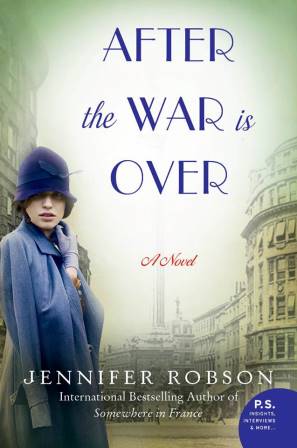
After the War is OverCharlotte works in an office in Liverpool that tries to find help for the poor and destitute.  The circumstances of many families has become dire especially since The Great War has ended.  Veterans are coming home wounded and unable to work and women are left widows with children to feed.

Jennifer Robson vividly portrays the sadness and destruction that has been left in the wake of the war; everyone in England has been affected by this deadly and costly conflict.  There are several sub plots in the book that will give the reader a better appreciation of the variety of ways in which men and women from all walks of life had their lives altered by World War I.

Charlotte served as a nurse in a hospital in London that specialized in helping veterans from shell shock; her memories of the patients she helped there always haunt her.  But when her old friend, Edward, comes home from the war a changed man, she uses her expertise as a nurse to try and help him recover from his trauma.

There is obviously a history between Charlotte and Edward and the narrative flashes back to the time they spent together before the war.  But since they are from very different social classes, Charlotte assumes that they will never be romantically involved.  The scenes in the book in which Edward and Charlotte are getting to know each other were my favorite parts of the book.  My only complaint about the book is that Robson did not include more interaction between these two characters.

Overall, AFTER THE WAR IS OVER is a fantastic read if you have an interest in historical fiction set during and after World War I.


About The Author:
Jennifer RobsonJennifer Robson first learned about the Great War from her father, acclaimed historian Stuart Robson, and later served as an official guide at the Canadian National War Memorial at Vimy Ridge, France. A former copy editor, she holds a doctorate in British economic and social history from the University of Oxford. She lives in Toronto, Canada, with her husband and young children.

Please click on the TLC tour banner below to see the additional stops on this book tour:

tlc-logo-resized


1 Comment

Filed under Historical Fiction, World War I

Review and Giveaway: From The Fifteenth District by Mavis Gallant

Today I welcome France Book Tours back to my blog with an interesting collection of short stories.  I invite you to read my review, enter to win your own copy of the book, and visit the other stops on the tour.

My Review:
15th DistrictThis is a unique, and at times bizarre, collection of stories that are set in Western Europe before, during and after World War II.  The characters in the stories are not soldiers or directly fighting in the war, but their lives are in many ways deeply affected by the war.  All of the stories are melancholy in tone and have a stream of consciousness feel with meandering narratives.

I enjoyed the story “Four Seasons” because it showed how this war affected citizens all over Europe.  A British family is living on the coast of Italy and barely making ends meet as they are running a small printing business out of their home.  This story is typical of the collection in that it has a melancholy tone and none of the characters seem happy with their lives.

The husband and wife barely interact with each other or their twin girls who are toddlers.  When they hire a nanny who is an Italian girl that barely speaks English, they do not bother to get to know her very much either.  As the outbreak of the war threatens, the family is forced to travel back to Britain and we are left wondering what might have happened to the family and their children’s caretaker.

In the “Moslem Wife,” we at first learn about the history of a husband and wife who are first cousins.  They run a hotel on the French Riviera which they inherited from Netta’s parents.  The narrative style of this story is typical of the whole collection in that wanders haplessly from one character to the next and sometimes feels rather random.

The author takes us through the stories of different characters who visit the hotel, including Jake’s mother, and the eccentric friends of Jake’s mother.  When Jack ends up in America and cannot get back to Europe because of the war, their marriage undergoes an obvious strain.  Will the couple end up together again after a long separation of five years?  Will the war, like many things in Europe, destroy their relationship?

If you enjoy historical fiction set during World War II, then these stories are definitely worth giving a try.  They are certainly unique among the vast array of short stories I have read and reviewed.

About The Author:

From the 15th district Mavis GallantIn 1952 Mavis Gallant (1922–2014) left a successful career as a journalist in Montreal to live independently as a writer of fiction in Europe. She had gained international recognition in 1951 when she was published in the New Yorker, which in subsequent years released over one hundred of her short stories, most of which are set in European cities or Montreal. Random House published twelve volumes of her work. Gallant was awarded the 1981 Governor General’s Award for Home Truths, the 2002 Rea Award for the Short Story, and the 2004 PEN/Nabokov Award for lifetime achievement.  She was a companion of the Order of Canada, the country’s highest honor.  After traveling widely in Europe, in 1960 Gallant settled in Paris, where she died in 2014. The Journals of Mavis Gallant: 1952–1969 is tentatively scheduled for publication by Alfred A. Knopf in 2015.

See more books by Mavis Gallant.

Follow Open Road Integrated Media on Facebook | Twitter

Giveaway:
Open to US residents only. You may choose either a kindle or epub of this book. Click on Entry-Form below to enter the giveaway and follow the instructions:
Entry-Form

CLICK ON THE BANNER BELOW TO READ OTHER REVIEWS, AND AN EXCERPT:

From the 15th district banner

6 Comments

Filed under Historical Fiction, Short Stories

Review and Giveaway: Death of a Dishonorable Gentleman by Tessa Arlen

Today I welcome Historical Fiction Virtual Book Tours back to the blog with an historical fiction mystery.  I invite you to read my review and enter to win your own copy of the book (US only).

My Review:
01_Death of a Dishonorable GentlemanSet at the turn of the 20th Century, just before the Great War, this mystery takes place on the lavish estate of Lord and Lady Montfort after their annual summertime ball.  I have read many reviews that have compared the setting of this book with that of Downton Abbey and I would say that is a very accurate assessment.  The narrative jumps back and forth between Lord and Lady Montfort and their privileged class, and the servants which include maids, footmen, cooks, and butlers,  who are “below stairs.”

After the traditional summer costume ball, Lord Montfort’s reprobate nephew, Teddy, is found murdered and everyone who is at the ball becomes a suspect.  All of the guests are required to stay on the estate while the authorities conduct their investigation.   As the story unfolds, it seems that many people had a reason to want Teddy out of the way.

The author spends a lot of time describing the British upper class and their insistence on observing traditional roles and divisions of class that have existed in that country for centures.  When the Lady of the house and her housekeeper, Mrs. Jackson, team up together to solve the murder mystery, they are both uncomfortable with breaking of the traditional servant-master relationship.

The strongest part of the book was the last quarter of it in which Mrs. Jackson is actively conducting her investigation and more details are revealed about the last hours of Teddy’s life.  Is it one of the nobility that could have pulled off such a heinous crime, or could one of the servants have had a grudge against this dishonorable man?

About The Author:
02_Tessa ArlenTessa Arlen, the daughter of a British diplomat, had lived in or visited her parents in Singapore, Cairo, Berlin, the Persian Gulf, Beijing, Delhi and Warsaw by the time she was sixteen. She came to the U.S. in 1980 and worked as an H.R. recruiter for the Los Angeles Olympic Organizing Committee for the 1984 Olympic Games, where she interviewed her future husband for a job. DEATH OF A DISHONORABLE GENTLEMAN is Tessa’s first novel. She lives in Bainbridge Island, Washington.

Giveaway:
Open to US residents only. Giveaway ends 2/6
– Must be 18 or older to enter.
– Giveaway is open to US residents only.
– Only one entry per household.
– All giveaway entrants agree to be honest and not cheat the systems; any suspect of fraud is decided upon by blog/site owner and the sponsor, and entrants may be disqualified at our discretion
-To enter, leave a comment below and let me know you want to win! The winner will be notified via email and will have 48 hours to respond.

The Winner of the Giveaway is: Carl S.

Click on the tour banner below to visit all of the stops on the tour.

03_DOADG_Blog Tour Banner_FINAL


24 Comments

Filed under Historical Fiction, Mystery/Thriller

Guest Post: Author Marie Savage On How to Begin An Historical Fiction Novel


Today I welcome Marie Savage to The Book Binder’s Daughter who is writing about her new book Oracles of Delphi and her process of beginning an historical fiction novel.  I invite you to read her interesting guest post, enter to win your own copy of her book and visit the other stops on the tour.

Great beginnings: Setting the historical scene to keep the reader turning the pages

As a writer, editor, publisher, and avid reader, I think a lot about how to draw a reader into a story and keep them turning the pages. All good stories must have a powerful beginning that not only hooks the reader immediately, but also sets the mood and gives tantalizing clues about what is to come. In historical fiction, the beginning has to do even more work—it has to transport the reader to a time and place that may be completely unfamiliar.

9780989207935-Perfect.inddThere are many ways to grab a reader from the very first line and first paragraphs, and in writing ORACLES OF DELPHI, set in 340 BCE, I think I tried them all before I got it “right.” I probably rewrote the first chapter fifty times, and that’s no exaggeration. Ultimately, I believe, a successful beginning boils down to a deft use of tension and in ORACLES, the first paragraph plunges the reader directly into the story, gives a sense of the time period, and sets up the tension between two characters:

Nikos’s heart pounded against his rib cage like a siege engine. He pressed his back into the stone wall, closed his eyes, and tried to calm his breathing. He couldn’t believe he’d been such a fool. “Next time I’ll surrender the prize,” Charis had always promised. Next time he would claim it, he always hoped. But instead….

He pulled himself to the top of the wall and lay flat. The moment of escape calmed him. The gates of the Sacred Precinct were locked, and he’d had to climb out the same way he’d climbed in. On the way out, though, he wasn’t carrying a body.

He glanced to his side, toward the theater, and then down to the Temple of Apollon where he’d left Charis’s body for the priests to find. Stars winked in and out as clouds drifted across the black dome blanketing the night sky. He crouched, reached for a nearby branch, and swung down to land on the ground with a soft thud.

Does it work? With references to the siege engine, the Sacred Precinct, and the Temple of Apollon, does it put you in the scene and in the time period? Will it keep you reading? I hope so. Here’s one of my favorite beginnings, this one by Deborah Lincoln whose book, AGNES CANON’S WAR, I edited and published.

Agnes Canon saw a woman hanged on the way to the Pittsburgh docks. The rope snapped taut, and a hiss rose from the watching crowd like steam from a train engine. The woman dangled, ankles lashed together, hooded head canted at an impossible angle, skirt flapping lazily in the breeze. A sharp pang of sorrow shot through Agnes though she knew little of the woman’s story.

I love this first paragraph because it puts you right into the story. In the first line, we read “Agnes Canon saw a woman hanged on the way to the Pittsburgh docks” but we don’t know why she was going to the docks—does she work there? Is she meeting someone there? Or is she going on a journey, leaving from the docks to parts unknown? Second, we know immediately that the story is set in a time during which hangings were done in public and steam engines were common. Third, the description of the woman’s body dangling with “ankles lashed together, hooded head canted at an impossible angle, skirt flapping lazily in the breeze” grabs the reader and immediately begs the question: what was this woman’s crime? Last, we discover that although Agnes knows little of the woman’s story, she knows enough to feel sorry for her, and that sympathy tells the reader something of Agnes’s character.

A good beginning should not be loaded down with adjectives and adverbs, but careful use of descriptive language can be effective in setting the mood, anchoring a story in time and place, and evoking a particular atmosphere. Below is the first paragraph from SLANT OF LIGHT, an award-winning Civil War-era novel from Steve Wiegenstein.

The keelboat moved so slowly against the current that Turner sometimes wondered if they were moving at all. Keeping a steady rhythm, Pettibone and his son worked the poles on the quarter-sized boat they had built to ply the smaller rivers that fed the Mississippi. Whenever the current picked up, Turner took the spare pole and tried to help, but although he was tall and muscular, with a wide body that didn’t narrow from shoulders to hips, poling a boat wasn’t as simple as it looked. He pushed too soon, too late, missed the bottom, stuck the pole in the mud, all to the amusement of Pettibone’s son, Charley. And with every stroke, Turner asked himself: What in all creation am I doing here?

In this paragraph, we know immediately that the story is set in the past as keelboats are not common modes or transport these days. And we know that Turner, who is tall and muscular, is unused to working the poles—something even a young boy can do. Turner is clearly a guest on the keelboat or has hired Pettibone and Charley to transport him. But transport him where? We know the boat is plying a tributary of the Mississippi, but what is Turner doing there and where is he going? The last line sets up the rest of the novel, hinting that discovering why Turner is on that keelboat in the first place is at the heart of the story.

What are your favorite first paragraphs and what elements draw you in and keep you turning the pages?

-Marie Savage

About The Author:

02_Marie Savage_Author PhotoMarie Savage is the pen name of Kristina Marie Blank Makansi who always wanted to be a Savage (her grandmother’s maiden name) rather than a Blank. She is co-founder and publisher of Blank Slate Press, an award-winning small press in St. Louis, and founder of Treehouse Author Services. Books she has published and/or edited have been recognized by the Independent Book Publishers Association (IBPA), the Independent Publisher Book Awards (IPPY), the Beverly Hills Book Awards, the David J. Langum, Sr. Prize in American Historical Fiction, the British Kitchie awards, and others. She serves on the board of the Missouri Center for the Book and the Missouri Writers Guild. Along with her two daughters, she has authored The Sowing and The Reaping (Oct. 2014), the first two books of a young adult, science fiction trilogy. Oracles of Delphi, is her first solo novel.

Giveaway:

Marie is giving away one copy of her book (US/CAN).  Just leave me a comment below and let me know you want to win.  It’s that easy!  One winner will be chosen on Jan.9th and notified via email.  The winner will have 48 hours to respond.

Click on the Tour Banner below to view the full list of blogs participating in the tour!

04_Oracles of Delphi_Blog Tour Banner_FINAL


3 Comments

Filed under Author Interviews, Historical Fiction