
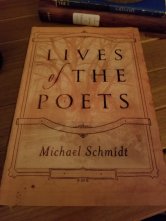
 I still making my way through Schmidt’s Lives of the Poets. I can only read about 20 or 30 pages a week because I keep stopping to read the poems he discusses in his text. What is equally fascinating are the details he chooses to include in his brief biological sketches of each poet. The poets from the fifteenth through the seventeenth centuries have some common threads: poverty, affairs, political intrigue and imprisonment in The Tower. But he also works in stories and anecdotes that I have not typically encountered when reading about these poets. My two favorite chapters, so far, are those describing the lives of Donne and Milton.
John Donne, like many of the poets from the 17th century including Herbert, Marvell and Vaughan, did not consider themselves professional writers. His manuscripts were circulated among a small group of friends but most knew him as a political and religious orator and not as a poet. One of Donne’s preoccupations was with death and how his demise would be handled by his relatives when he passed from this earth. Schmidt writes, “Most men allowed their survivors to bury the as they thought appropriate. Donne took his death into his own hands. The rehearsals as much as the memorial tell us more about him than we could learn from the rooms he lived in.” Schmidt goes on to quote from Izaac Walton’s “Life of Donne”:
Dr. Donne sent for a carver to make for him in wood the figure of an urn, giving him directions for the compass and height of it; and to bring with it a board of the just height of his body. These being got, then without delay a choice painter was got to be in readiness to draw his picture, which was taken as followeth.—Several charcoal fires being first maed in his large study, he brought with him into that place his winding-sheet in his hand, and, having put off all his clothes, had this sheet put on him, and so tied with knots at his head and feet, and his hands so placed, as dead bodies are usually fitted to be shrouded and put into their coffin, or grave. Upon this urn he thus stood with his eyes shut, and with so much of the sheet turned aside as might show his lean, pale and deathlike face.”
I will never look at Donne poem the same again after reading these morbid, and somewhat creepy, details.
The biographical summary of Milton’s life includes more charming personal stories. For example, Milton’s father encouraged his son to read and, “If Milton as a boy of nine of ten wanted to read late, his father made sure that a maid sat up with him until midnight and after.” The details of his education I found especially interesting:
When he went up to Christ’s College, Cambridge, in 1625 he found the place disappointing, the curriculum dry and narrow. He craved a broader, more liberal education than was offered. He composed Latin poems in the manner of Ovid and Horace, epigrams, a Latin mock-epic on the Gunpowder Plot, Italian sonnets, more English paraphrases of the Psalms, and the eleven stanzas “On the Death of a Fair Infant Dying of a Cough.” His Latin elegies are in some ways his most personal utterances, including details of his life and thought not recorded elsewhere. He was at the time as much at home in Latin as in English verse.
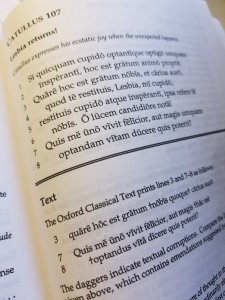
I’ve tracked down some of his Latin which I will try to translate for myself. And Schmidt has also inspired me to reread Paradise Lost which I haven’t looked at since I was an undergraduate. At this rate I will be spending my time with Schmidt’s book for the better part of this year…
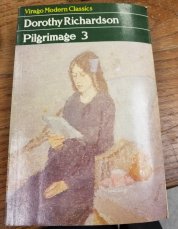 The timing of my reading Dorothy’ Richardson’s paragraph in Deadlock on the symbolism of walls could not have been more perfect:
 I was just going to tweet the text of this poem, but Michael Hamburger’s translation of Goethe’s Roman Elegies is so sublime and beautiful that I decided it deserved a blog post instead. I have been reading, along with his autobiography A String of Beginnings, the Michael Hamburger Reader from Carcanet Press. In addition to his translations, this fabulous volume contains his own poetry and essays. Hamburger, who began translating Goethe at the age of fifteen, comments about his poetry: “To reflect on the untranslatability and elusiveness of Goethe’s poetic work as a while is to go straight to the heart of his uniqueness, his staggering diversity and the extent to which many of his most original poems—especially the earlier lyrics—are inextricably rooted in their own linguistic humus.”



 The Book Binder's Daughter