Category Archives: Uncategorized

Happy New Year

New Year PicI have never really made a big deal about New Year’s as a holiday.  I am usually one to stay home with my family and am in my pajamas by the fire when the clock strokes midnight.  But this year, a quote from one of my favorite books keeps recurring to me:

“For you have only one life; and whatever the circumstances are that have been given to you, only you have the power, through the grace of God, to make that life a story with telling.”
-Stuart Shotwell, Tomazina’s Folly

Happy New Year, from The Book Binder’s Daughter.


4 Comments

Filed under Uncategorized

Review- A Day of Fire: A Novel of Pompeii by Stephanie Dray, Ben Kane, E. Knight, Sophie Perinot, Kate Quinn and Vicky Shecter

I received a review copy of this novel from one of the authors.

A Day of FireNot only did the topic of this book interest me, but also the unique format with which it was written.  This is the tale of those who witnessed the last hours of the famous, or infamous, city of Pompeii that was buried in 79 A.D. by the ash and soot of Mt. Vesuvius.  There are a total of 6 different stories in the collection, all written by 6 different authors.  Several of the characters do overlap, however, seamlessly throughout the narratives.  For instance, the prostitute that The Younger Pliny visits in the first story, has a tale in her own words at the end of the collection.  The stories feature men and women from different social strata during the time of the Roman Empire: a senator, an ex-soldier, a wealthy merchant and an heiress, just to name a few.

The strongest story in the collection is that which surrounds a young girl of fifteen who is an heiress to a large wine fortune.  Aemilia is betrothed to marry a man that is much older than her and whom she did not choose.  This situation, of course, is not uncommon among the Roman upper class who are trying to guard the virtue of their daughters and the continuance of their vast fortunes.  Although she has known Sabinus for her entire life, Aemilia has never had any romantic feelings for him.  But her father wants to ensure a safe and secure match for his only daughter.  As the wedding day approaches, and Vesuvius erupts, we are left to wonder if the wedding will ever take place.  I found the characters in this story the most developed and interesting of the entire collection.

As the fates of the various characters unfold in each story, the big question that lingers is who will survive and who will be swallowed up by the volcano?  The destruction of Vesuvius makes no class distinctions and everyone, whether Patrician, Plebian or slave is not exempt from its impending doom.  The suspense that lingers in each story is also a strength of the book.

I can understand the need to educate the reader about Roman customs, but some of the details given in the stories felt unnecessary and even cumbersome and pedantic.  At times the stories had a bit of a textbook feel and the minutiae interrupted the flow of the story.  For example, the extended description of Pliny The Younger’s first experience at a brothel was more detailed than it needed to be and superfluous to the advancement of the plot.  In fact, there are a lot of details about sex, brothels, and prostitutes in this book; such lasciviousness is a stereotype that so many historical fiction books set in Rome tend to dwell upon.  Furthermore, the scenes of fighting in the arena between two gladiators sounded a lot like the PowerPoint presentation I give my students when I am teaching about Roman forms of entertainment.

I do applaud the authors for using so many Latin words to describe various Roman objects, ideas and customs.  However, I wonder if this is distracting to a reader who does not know Latin?  I would image that, to fully appreciate the context of words such as cacator, viridarium, aedile, etc., there must be a lot of Internet searches involved with reading this book.  Maybe an index of Latin terms might have been useful to the reader?

Overall, this book captures the terror that the victims of mighty Vesuvius most certainly would have experienced in their final moments.  If you want to learn more about Roman culture during the 1st Century A.D. then I recommend A DAY OF FIRE.

3 Comments

Filed under Uncategorized

Happy Thanksgiving

I am so grateful for all of the readers, followers, authors and fellow bloggers I have connected with this year.

Happy Thanksgiving

5 Comments

Filed under Uncategorized

Book Spotlight: Renaria- Into The Adyton by J.L. Wilson

I don’t usually read science fiction or fantasy books, but when I came across author J.L. Wilson’s Facebook page I was intrigued by the title of her new book.  As many of you know, my day job is teaching Latin, Ancient Greek and History and the word “Adyton” is very important to the God Apollo and his temple in Delphi.  It is a very obscure word that many people have never heard of and I was impressed that it was in the title of the book.

I asked J.L. Wilson about the title and she agreed to send me a little synopsis and explanation about her book so I could share it with my readers.  It looks very interesting and I am excited to see the connections with Greek myths in her book.

In J.L. Wilson’s own words: Renaria – Into the Adyton released on Nov. 7th, 2014 and is my debut Sci-Fi fantasy novel. With elements of mythology, magic, and gaming it generally leans Young-Adult, but I think it can be enjoyed by anyone ages 9-99. Readers have compared it to Divergent, Harry Potter, Narnia, and Jumanji.

Book Synopsis:
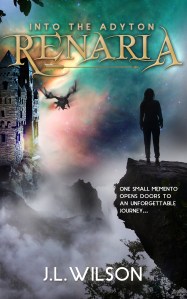
Renaria - JLWilsonA small memento, a universal power…

It’s the year 2126, post-World War V. Leda, age seventeen, bounds through the lush forested region of the Desintor Foothills as a regal, bow-wielding, High-Elf Scout. That is, when she’s logged into her favorite MMO game: Renaria.

One crisp fall afternoon, an unseasonal storm fractures the sky of Trinton, New Texas with splinters of emerald lightning and otherworldly songs. Oddly, no one sees the storm except her brother and their guild mate Travis.

She brushes off the event as a fluke, but she can’t seem to get the song out of her mind. Suddenly, a new quest appears in her game directing her to the blue sand dunes of the Sinare Desert to meet Caleb, a legendary Elf Diviner.

Now she has a choice: Ignore the quest and turn off the game, or dive in and risk everything for a shot at an adventure.

Although not the main theme in book 1, J.L. Wilson’s interests in Greek Mythology and Astrophysics led her to interweave mythological characters into a “current” day, real-world setting. Characters related to Nyx (Night) and Erebos (Darkness), for example, are introduced in book one.

Author Bio:

J.L. Wilson’s interests in Sci-Fi, Fantasy and video games grew from years of watching Star Trek, thanks to her mother. During her graduate studies in anthropology she focused primarily on humans and their interaction with technology. All kinds! Language, tools, cyborgs, etc. She reads anything she can get her hands on that involve space, wizards, or video games. In her debut fantasy novel, Renaria: Into the Adyton, she sought out to weave these interests together.

When not writing or reading you can find her in World of Warcraft, FFXIV or the latest MMORPG creating new characters or exploring new quests. She’s on Facebook and Twitter and currently lives in Texas with her husband, four kids (cats) and a dog.

Currently the book can be found in eBook format or paperback on Amazon.

add-to-goodreads-button3


Leave a comment

Filed under Uncategorized

Recitatio: Social Media, Ancient Style

Today I am very excited to be writing a guest post for author Harry Patz on his website The Naive Guys.  As many of you know, my day job is a Latin teacher.  My two passions, reading and teaching the Classics, have collided in this essay.  I explain how Roman authors went about selling their books and I compare it to how authors, especially Indie authors, sell their publications in the 21st century.  Read my post here..

Pillar Clip Art

Leave a comment

Filed under Uncategorized