Category Archives: Uncategorized

I Can Remember Still the Sun: A Poem by Gamel Woolsey

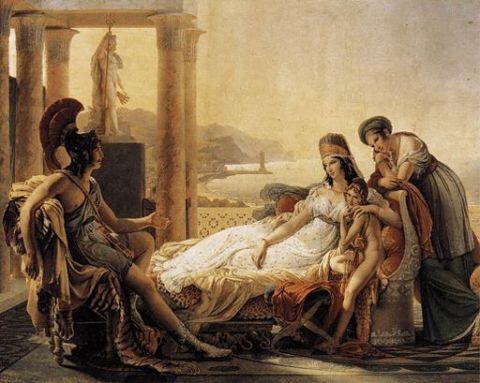
Dido and Aeneas. Pierre-Narcisse Guérin. Oil on canvas, c. 1851.

Gamel Woolsey uses one of Vergil’s most famous lines from The Aeneid as inspiration for her imposing yet brief poem:

“Forsan et Haec Olim Meminisse Iuvabit”
(“Perhaps one day it will be a pleasure to remember even this…”)

Why should you feel remorse, regret,
For what was beautiful to me,
As uncommanded as the sea?
The winds blew and the waters sang
All summer: now that summer’s done
I can remember still the sun
That lay upon the mountain grass,
And all the beauty that there was –
Only remember what was fair,
And what was wild and innocent;
The rest is blown upon the air.

Woolsey was born in South Carolina in the United States and lived in New York City for a while before moving permanently to England.  Her love affair with Llewelyn Powys prompted her to take up residence near him in Dorset.  She later married writer Gerald Brenan and they lived together in Spain and England until her death in 1968.

While visiting my favorite bookshop in Maine I came across one of Woolsey’s novels, One Way of Love,  published posthumously in 1987 by Virago Press.  I am hoping to read it before the end of summer.

6 Comments

Filed under Uncategorized

Living in the Open: On Not Knowing Greek by Virginia Woolf

After reading Tolstoi’s Love Letters published by The Hogarth Press which collection Virginia Woolf is credited as co-translator although she didn’t know Russian, I reached for Woolf’s essays in which she discusses different cultures and the art of translation.  In “On Not Knowing Greek,” she argues that the Greeks conducted their lives outside, in the open air, and communicated with one another more succinctly and dramatically.  For the English, she argues, who are prone to living indoors, having discussions in the drawing room and writing massive novels filled with thousands of words, Greek literature and culture is something that can never be fully understood.

A people who judged as much as the Athenians did by ear, sitting out-of-doors at the play or listening to argument in the market-place, were far less apt than we are to break off sentences and appreciate them apart from the context.  For them there were no Beauties of Hardy, Beauties of Meredith, Sayings from George Eliot.  The writer had to think more of the whole and less of the detail.  Naturally, living in the open, it was not the lip or the eye that struck them, but the carriage of the body and the proportions of its parts.  Thus, when we quote and extract we do the Greeks more damage than we do the English.  There is a bareness and abruptness in their literature which grates upon a taste accustomed to the intricacy and finish of printed books.  We have to stretch our minds, to grasp a whole devoid of the prettiness of details or the emphasis of eloquence.  Accustomed to look directly and largely rather than minutely and aslant, it was safe for them to step into the thick of emotions which blind and bewilder an age like our own.

She begins the essay by asking why we should bother to learn Greek since the gap between our culture and theirs is so wide.  Her final sentence in the essay answers it perfectly and reminds me how grateful I am to know and study this beautiful language:

With the sound of the sea in their ears, vines, meadows, rivulets about them, they are even more aware than we are of a ruthless fate.  There is a sadness at the back of life which they do not attempt to mitigate.  Entirely aware of their own standing in the shadow, and yet alive to every tremor and gleam of existence, there they endure, and it is to the Greeks that we turn when we are sick of the vagueness, of the confusion, of the Christianity and its consolations, of our own age.

15 Comments

Filed under Uncategorized

τι μέγεθος: Some Kind of Magnitude in Eliot’s The Mill on the Floss

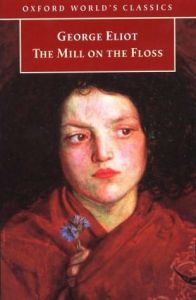
In the early chapters of The Mill on the Floss, George Eliot describes Maggie, her young, feisty and vivacious heroine: “There were passions at war in Maggie at that moment to have made a tragedy, if tragedies were made by passions only; but the essential τι μέγεθος (some kind of magnitude) which was present in the passion was wanted to the action.”

τι μέγεθος is a phrase from Aristotle’s Poetics* which he uses to describe an action of “some kind of magnitude” that is an essential part of any tragedy.  Maggie has a passion for life that makes her charge forward into deeds and actions that other “nice” little girls would never dare.  The descriptions of her mop of wild, thick hair and her darker skin also make her stand out amongst other girls her age.  One of my favorite scenes that demonstrates Maggie’s unbridled spirit and her refusal to conform to expectations is when she listens to the music from her Uncle Pullet’s snuff-box.  She can’t sit quietly and listen like the other children, but immediately jumps up and expresses the emotions stirred up through the music by grasping her older brother, Tom: “But when the magic music ceased, she jumped up, and, running towards Tom, put her arm around his neck and said,  ‘O, Tom, isn’t it pretty.'”  Unfortunately for Maggie, Tom had a glass of cowslip wine in his hand which was spilled during Maggie’s enthusiastic embrace.  As a result, Maggie is, once again, subject to a litany of scolding from the adults:

‘Why don’t you sit still, Maggie?’ her mother said, peevishly.

‘Little gells mustn’t come to see me if they behave in that way,’ said aunt Pullet.

‘Why, you’re too rough, little miss,’ said uncle Pullet.

But these numerous reprimands never deter Maggie or dampen her spirit and I find myself admiring the girl because of her bravery.  Eliot is obviously foreshadowing an event that will be much more tragic, of some kind of greater magnitude for her heroine.  I am glad to have this book to keep me company on what is supposed to be a lovely spring weekend here in New England.  I would enjoy hearing about what others are reading this weekend.  Let me know in the comments.


*Aristotle Poetics 1450b: κεῖται δὴ ἡμῖν τὴν τραγῳδίαν τελείας καὶ ὅλης πράξεως εἶναι μίμησιν ἐχούσης τι μέγεθος. (It occurs to us that tragedy is the mimesis (imitation) of a complete and whole action and some kind of magnitude.)

18 Comments

Filed under Uncategorized

Love’s Obstacles: Subleyras’s Diana and Endymion

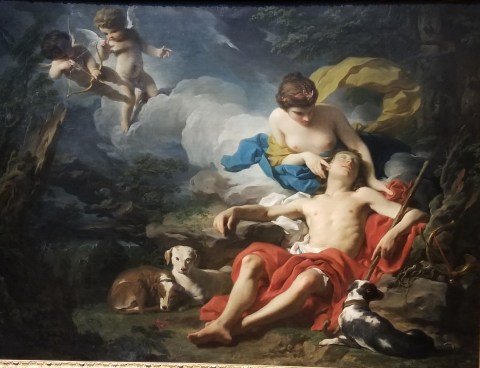
Diana and Endymion. by Pierre Subleyras. 1740 Oil on Canvas.

When visiting a large museum like The Met or a gallery as immense as The National Gallery my habit is to wander though the collections and see what catches my eye.  During my recent visit to The National Gallery while I was in London, I kept circling back and spending time with Pierre Subleyras’s painting of Diana and Endymion.  The image reminded me of Ovid and his various descriptions of transformations in the Metamporhoses, especially as they relate to the theme of love.   There are many variations of the myth, but I suspect Subleyras had in mind the version in which Endymion is an Aeolian shephard who captures the attention of the goddess Diana. What makes the story particularly striking is that Diana is a virginal goddess but her attraction to Endymion  overrides her proclivity for solitude.  (It is even said in one myth that the couple bear fifty daughters.) Diana asks Jupiter to give Endymion eternal youth and he is also placed in a cave where Diana can visit him every night and admire him in his sleep which is her favorite way to view him.

I find it fascinating that Ovid doesn’t include this story as part of the Metamorphoses, but instead writes a few poignant and striking lines about Endymion in Heroides XVIII.  Ovid composes a letter from Leander, a young man who sneaks out of the house at night to swim the Hellespont so he can be with and make love to a young woman named Hero.  Hero, a devotee of Venus, lives in a tower and lights a lamp each night for Leander so he can find his way to her.  As Leander is reminiscing about his noctural swims, he invokes the image of Endymion and Diana (translation of Heroides XVIII.57-66 is my own):

No more delay, instead I threw off my clothes

along with my fear and I launch my pliant

arms through the liquid sea.  The moon, like a

dutiful companion along my path, was offering

her trembling light to me as I was gliding along.

And I, looking up at her, said, “May you,

oh shining goddess, support me and may the

rocks of Latmos rise up in your mind.  Endymion

does not allow you to be severe in your heart.  Turn

your face, I pray, to help me in my secret love. You, as

a goddess, glided down from heaven to seek a mortal

love.  May it be permitted for me to speak the truth!—-

The woman whom I pursue is herself a goddess.

As I am drawn back again and again to that peaceful look on Endymion’s face in the Subleyras painting, I can’t help but think that he must have been a soothing presence for Diana.  As I contemplate the painting in relation to both of these myths, their many parallels make themeselves evident; if Diana wouldn’t let a little thing like mortality stand in the way of love, then Leander can’t let geography or  the sea impede his way either.  If only Endymionis somnium dormire (to sleep the sleep of Endymion.)

For the extra curious, here is a link to the Latin text: http://www.thelatinlibrary.com/ovid/ovid.her18.shtml

4 Comments

Filed under Uncategorized

The Juniper Tree by Barbara Comyns

The plot of The Juniper Tree is, at first, deceptively simple. Narrated in a matter-of-fact, emotionally detached tone, one would never guess the hardships and suffering that are yet to come in this story. Bella Winter escapes her cruel and harsh mother by moving in with a boyfriend who has a tendency to be verbally abusive towards her. Bella’s face is permanently scared in an car accident which her boyfriend, Stephen, causes. When their relationship finally dissolves, Bella moves on from Stephen but finds herself pregnant after a one night stand with a black man she never sees again.

But Bella is never bitter or harsh, she accepts her life and loves her daughter and even finds happiness by working in an antique shop. Bella’s daughter, Tommy, thrives on Bella’s love despite the fact that many people, including her own mother, are judgmental about her biracial daughter. Comyns’s depiction of what it is like for a single mother and her innocent daughter to suffer from racism in 20th century Britain is true to life and heartbreaking. I was captivated by Bella’s simple yet happy outlook as she doesn’t view her scar, her daughter or her occupation as obstacles to her contentment. But Comyns draws the reader into the tragedy that will eventually occur in brilliantly subtle ways.

When Bella meets Bernard and Gertrude Forbes, a wealthy couple who take Bella and Tommy under their wing, hints of tragedy start to appear. Although she spends weekends at the Forbes’s well-appointed home and garden and becomes a integral part of their family by helping them with domestic chores, Bella still retains her freedom and cherishes her antique shop and her own space. Bernard, in particular, seems patronizing towards Bella and views her as his pet project. His attempts to educate her about art, music and languages reminded me a bit of Ovid’s Pygmalion myth.

Tragedy strikes in the story when Bella, against her better judgment, gives up her freedom. She thinks she is making decisions to enhance her daughter’s education and future, but she knows that sacrificing her own, simple joys, is a bad decision. This book is equally as important and relevant in the 21st century as a commentary about women, social roles, and the balance that mothers and wives have to make between the comfort and safety of their families and their own individual needs. It’s something I struggle with personally every day.

Leave a comment

Filed under Uncategorized