Category Archives: Uncategorized

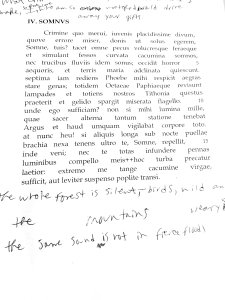
A Plea for some Sleep: Somnus by the Roman Poet Statius

Rereading Dante has sent me down many an interesting rabbit hole, one of which includes reexamining the works of the Silver Age Roman poet Statius.  I have not translated Statius for many years because my first encounters with his epics, in particular, were not pleasant ones.  But Purgatory has inspired me to pick up Statius once again—I will read and translate sections of his epics the Thebaid and the Achilleid.  More on those two pieces of literature in a later post, but as a preview I offer here a translation of one of Statius’s poems from his collection entitled Silvae.

Silvae in Latin means either “forests” or “materials”, a fitting name for what Statius meant to be occasional poems that are written hastily or on the spur of the moment.  Divided into four books, the Silvae include poems in praise of the Emperor Domitian, consolation poems, and commentary about ordinary things like a tree or sleep.  In the preface to Book I Statius writes about his compositions (all translations of Latin are my own): mihi subito calore et quadam festinandi voluptate fluxerant cum singuli de sino meo prodiderint—“with a passion and a certain desire for haste they suddenly flowed from me and each individual one was produced from my heart.”

I offer here my translation of Silvae IV entitled “Somnus” (Sleep) which is a plea to this fickle god to cure the poet’s insomnia. I especially identified with these verses because the beginning of a new semester, the unusual heatwave and a variety of other factors have also brought me a long bout of insomnia:

Oh most peaceful of gods, youthful Sleep, what crime have I committed, what mistake have I made, to cause me to be so wretched and to lack your gifts? The entire herd is silent, the birds, the wild animals and the curved tree tops all have the appearance of weary sleep. Even the fierce rivers do not have their usual sound; the shuddering of the waves has died out and the oceans, leaning on the earth, grow quiet. The moon, returning seven times now, has looked down on my sullen face. So often have the lights of Oeta and Venus revisited me and so often has Aurora walked past my groans, sprinkling me, in pity, with her cold whip. How will I get through this? I couldn’t bear this even if, like sacred Argus, I possessed the thousand eyes which he was used for an alternating vigil and which were never awake all at once. But, ah now, alas! If any lover, during the long nighttime hours, holding his arms entwined around a girl, drives you away from him on purpose, then please come to me instead; I do not ask that you pour all the power of your wings over my eyes—only a man who is much happier would pray for this;  but touch me with the very tip of your wand—for that is enough—or tread over me lightly with your raised foot.

One interesting thing to note is Statius’s heavy use of characters and names from history and mythology.  In order to understand fully this short poem,  one must look up or know something about Oeta, Venus, Aurora, and Argus.  He uses the same heavy-handed technique in the Thebaid.  As promised, more on that later.  But I am glad that Dante has goaded me to take another look at Statius.

7 Comments

Filed under Uncategorized

A Lofty, Old Oak Tree: Pompey in Lucan’s Pharsalia

My friend and I were having our daily lunchtime walk when we were discussing the fact that his is my 20th year of teaching secondary school—it hardly seems possible that I have been in my profession for that long! During the same conversation she also reminded me that next month is my birthday and she said out loud the age that I will be turning. I was so shocked to hear the number spoken out loud that I had the urge to slap her on the arm! I know that my birthday is coming up but I didn’t actually think about the age I am going to be. I told her all this, of course, and we had a good laugh about it. And this conversation brought to mind the image of the poet Lucan’s description of the Roman general Pompey who, compared to a younger and more vigorous Julius Caesar, is at a great disadvantage when they are at war with one another. Lucan says about Pompey’s former glory and advancing years (translation is my own):

Thus Pompey now stands as a shadow of his great name; similar to a lofty oak tree standing in a fertile field, bearing the old mementos of its people and the sacred gifts of its leaders, no longer fixed to the earth with strong roots, it remains upright merely because of its own weight; and lifting its naked branches into the air, it casts a shadow not with its leaves but with its trunk. And even though it shakes and threatens to fall with the first strong wind, while other trees with more robust trunks grow around it, this oak tree alone is still revered.

I, of course, exaggerate for humorous effect—I don’t feel quite that old. I also have Lucan on my mind because I am rereading Dante’s Divine Comedy and this underappreciated Roman poet figures prominently in the Inferno. His uncle was the famous stoic philosopher, Seneca, who had a great influence on him while he was growing up. Lucan wrote his most famous work, an epic poem entitled the Pharsalia, during the reign of the Emperor Nero with whom Lucan had a close alliance and friendship. The Pharsalia (in Latin De Bello Civile) tells the story of the civil war between Pompey and Caesar that took place during the waning years of the Roman Republic. Written as a poem in dactylic hexameter, Lucan is indebted to Vergil and Ovid for his literary style. Neither Pompey nor Caesar are portrayed as heroes—each man is greatly flawed—and Lucan does not shy away from describing the horrible consequences of a civil war.

The short section I translated above is from Book 1 and, I think, highlights Lucan’s talent as a poet and an astute critic of his own country’s history. It is a fairly quick read and I highly recommend it for those who want a better understanding of Dante’s poems.

8 Comments

Filed under Uncategorized

Fleeing and Trying to find Solace: Lyric Novella by Annmarie Schwarzenbach

I was first inspired to read Schwarzenbach by Mathias Enard’s book Compass which mentions this often neglected and overlooked journalist, novelist and traveler.  Lyric Novella is set in 1930’s Berlin among the unsavory, underground world of theater halls and bars.  The unnamed narrator is a young man who has become obsessed with a stage dancer named Sybille;  each night he watches her perform and then waits to have drinks with her and sometimes he drives her home.  He thinks he is in love with her—he even calls it a love affair–even though they have never had a physical relationship and Sibylle does not return his feelings.  The narrator’s obsession with Sibylle wears him down to the point of exhaustion and illness.  What I found remarkable is that he never articulates his feelings for Sibylle—we have no idea what he sees in her physically or mentally—and yet he can’t break away from her.  He is clearly a lost, lonely, naïve young man who just wants to belong to someone or something.
The narrator eventually escapes from the city to the country where he tries to forget Sibylle and once again to take up writing which he seems to enjoy.  The author spends a great deal of time on contrasting descriptions of city versus country and autumn versus spring.  But a change of season and scenery do not cure him of his malady: he is clearly unhappy with his own life and is feeling lost—fleeing to a another place, no matter how different,  doesn’t fundamentally change what is going on inside him.  In the translator’s preface, Lucy Renner Jones points out that the young narrator’s struggle reflects the author’s own guilt, struggle and repression of her sexuality.  After the book’s publication, Schwarzenbach even admits that she meant her narrator to be a young woman and not a young man.  The translator’s concluding words provide keen insight into the author’s background and mindset and as a result the themes she explores in Lyric Novella become clearer:

Schwarzenbach’s real-life restlessness and constant travelling was undoubtedly a flight forward from her mother’s control.  She too, like the young man in Lyric Novella, spends her life fleeing and trying to find solace, often in foreign places and nature.  Chaste and in solitude, the young man in Lyric Novella writes about the story of his failure dare to love Sibylle openly, however, peace eludes him and he turns to loathing himself ‘because I have no obligations.’  Removing himself from his obsession does not remove the obsession itself but leads to another kind of torment. The paradox of Schwarzenbach’s obsessive travelling throughout her life was that it represented the promise of freedom and being in control, by literally putting herself in the driving seat.  But, much like the narrator in Lyric Novella, she had her emotional turmoil packed in her luggage.

This short book has piqued my interest in Schwarzenbach’s life of wanderlust and solitude.  I also have a copy of her non-fiction book All the Roads are Open which I will try next.


11 Comments

Filed under Uncategorized

Look at his Hands: Some Concluding Thoughts on Eliot’s Daniel Deronda

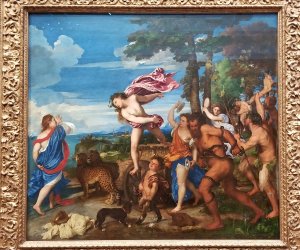
Titian. Bacchus and Ariadne. Oil on Canvas. 1520-3.

It is difficult to discuss Eliot’s eponymous hero in Daniel Deronda without giving away key aspects of her plot.  But I will share one of the most extraordinary passages in the novel that captures the strength, dignity and grace of Eliot’s hero:

Look at his hands: they are not small and dimpled, with tapering fingers that seem to have only a deprecating touch: they are long, flexible, firmly-grasping hands, such as Titian has painted in a picture, where he wanted to show the combination of refinement with force.  And there is something of a uniform pale-brown skin, the perpendicular brow, the calmly penetrating eyes.  Not seraphic any longer: thoroughly terrestrial and manly; but still of a kind to raise belief in a human dignity which can afford to acknowledge poor relations.

Time and again Deronda’s strong, graceful hands are extended to help those in need.  When he is rowing his boat along the Thames one evening, he finds a woman named Mirah in great distress and he does not hesitate to soothe her and to save her life:  “She stepped forward close to the boat’s side, and Deronda put out his hand, hoping now that she would let him help her in.  She had already put her tiny hand into his which closed round it, when some new thought struck her, and drawing back she said– ‘I have nowhere to go—nobody belonging to me in all this land.'”  Needless to say, Deronda does all he can to ensure not only Mirah’s safety but her happiness.

But Deronda does not discriminate when helping those in need.  He is capable of the most selfless kind of empathy and sympathy and extends kindness and compassion to those whom others might judge as undeserving.  Gwendolen, in her new marriage to Grandcourt, feels herself stuck in a miserable existence.  References to Dante abound in Eliot’s text and sometimes Gwendolen is depicted in a type of purgatory and at other times her life is described as pure hell.  It is just at the point of feeling like she will be pulled into the abyss of pain and sorrow that Deronda offers his steady hand:

Her hands which had been so tightly clenched some minutes before, were now helplessly relaxed and trembling on the arm of her chair.  Her quivering lips remained parted as she ceased speaking. Deronda could not answer; he was obliged to look away.  He took one of her hands, and clasped it as if they were going to walk together like two children: it was the only way in which he could answer, ‘I will not forsake you.’  And all the while he felt as if he were putting his name to a blanck paper which might be filled up terribly.  Their attitude, his averted face with its expression of a suffering which he was solemnly resolved to undergo, might have told half the truth of the situation to a beholder who had suddenly entered.

That grasp was an entirely new experience to Gwendolen: she had never before had from any man a sign of tenderness which her own being had needed, and she interpreted its powerful effect on her into a promise of inexhaustible patience and constancy.

I end my summer vacation of reading “loose, baggy monsters”  on a very high note with this remarkable book.  Middlemarch is still my favorite Eliot novel, but Daniel Deronda is a close second.  Tomorrow begins my twentieth year of teaching secondary school and I am as nervous, anxious, and excited as ever to face a new group of students.  I shall continue my reading of epic books into the autumn as Mann’s The Magic Mountain and Dante’s Divine Comedy have both caught my attention.  It seems fitting that today, for the first time in months, the humidity has broken and the air has a lightness and coolness to it that is refreshing and hopeful.


10 Comments

Filed under Uncategorized

Sorting the Stacks: Recent Photos of my Bookshelves

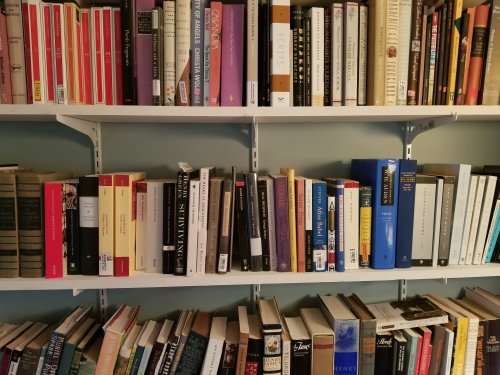
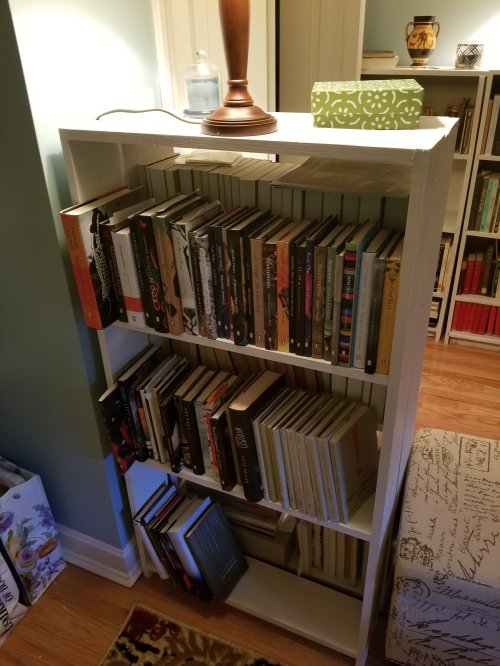
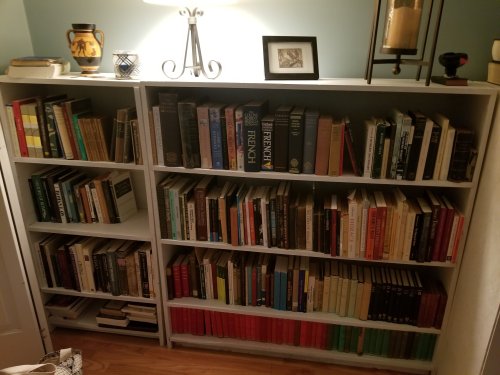
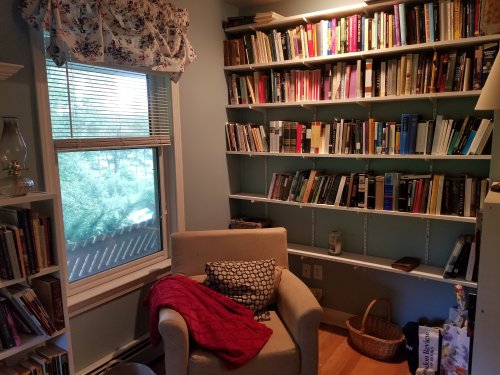
It took me three full days, but I finally reorganized my books. The piles in the living room were really getting out of hand and it was annoying to me how cluttered my collection was getting. On the first day of culling and sorting when most of my books had been pulled off the shelves and stacked into various piles around the house I wanted to give up, lie on the floor and cry. But I pressed on and am very happy with the results.

NYRB books and Fitzcarraldo editions

In a post a while back I discussed the conundrum of how one goes about organizing a large collection of books. Some do alphabetical, some sort by publisher and I’ve even seen a few organize books by color. I decided to go by nationality.

Top shelf are some German and French books, middle shelf is British lit and bottom shelf is American lit.

Well, mostly by nationally, I should say. I have a British section, an American section, a German section, etc. But I kept the Seagull books together as well as the NYRB books and a few other special publishers whose books I collect. I also have special sections dedicated to poetry, letters/memoirs, and essays.

Seagull books collection

This means that the Christa Wolf books are in the German section, except for her three books which are Seagull publications. So it’s definitely not a perfect system.

Persephone, Virago, and Classic Penguins

And the massive amount of classics books which are kept together have their own classification: Latin, Ancient Greek, Roman History, Greek History, Archaeology, etc., etc.

How do you sort your books?

33 Comments

Filed under Uncategorized